A compilation of links to inspiration, news, information, articles, editorials, commentary, entertainment, events, occurrences, resources, photographs, videos, quotes, contoversy, and conditions of interest to Pete Moss.

Search This Blog


Google


NEWS AND ANNOUNCEMENTS

*** All progress is experimental ~ John Jay Chapman ***

Top News

Real Clear Politics

Voice of Ameica - News

____________________________

Drudge Top Stories

Popular Science - New Technology, Science News, The Future Now

Entrepreneur.com - Small Business News and Articles - Latest Articles

Markets


WORLD CLOCK

Tropics Watch

hurricane satellite map

Latest Hurricane Info: [Link Me to NOAA]

[See The Latest Computer Models]
[DHL WORLD CLOCK]

[RADAR]


Latest Links & Articles Some older links may have expired

Miami, FL

Live From The International Space Station

Tuesday, April 23, 2013

Worst Job In America Is ...


Worst Job In America Is ...
By Dan Fastenberg
Posted Apr 23rd 2013 @ 8:28AM
Filed under: Top 10 Lists, Employment News & Trends


What is the worst job in America? In a troubled economy, where unemployment is high and the employed are overworked and underpaid, the competition is surely stiff. But each year CareerCast.com, the employment website, ranks 200 professions in America to come up with the answer.

The list is based on five factors: physical demands, work environment, income, stress and hiring outlook. This year, the 25th year of the CareerCast list, technological advancements appear to have complicated -- if not threatened -- several once-comfortable and sought-after American professions.

Not all jobs at the bottom of the list pay badly. One even pays an average salary of $60,750, while the average salary for a full-time worker in the U.S is around $41,000. In fact, the list of the worst jobs includes gigs that might always be considered desirable -- that is, once you reach the top of the field. Below are the bottom 10 on the list of 200 jobs, along with average salary information -- with No. 1 on the ranking being considered the least desirable. But tell us, what do YOU think is the worst job in America?

The Worst Jobs of 2013:

10. Flight Attendant -- Average income: $37,740.

9. Roofer -- Average income: $34,220.

8. Mail Carrier -- Average income: $53,090.

7. Meter Reader -- Average income: $36,400.

6. Dairy Farmer -- Average income: $60,750.

5. Oil Rig Worker -- Average income: $37,640.

4. Actor -- Average income: $17.44/hour.

3. Enlisted Military Personnel -- Average income:$41,998.

2. Lumberjack -- Average income: $32,870.

1. Newspaper Reporter -- Average income: $36,000.

Do you agree ? What do you think is the worst job in America? Share your comments below.

See the 10 best jobs.

12 Most Underrated Jobs In America

Civil Engineer
Computer Analyst
Automobile Mechanic
Electrician
Plumber
School Principal
Economist
Legal Assistant
Accountant
Market Research Analyst
Biologist (Biochemist or Biophysicist)
Veterinarian

Automobile Mechanic

Median Annual Salary: $36,200

Monday, April 22, 2013

Want to Write a Book?

http://www.bestsellerblueprint.com/freetraining/

STRESSED & DEPRESSED AMERICANS 'SNAPPING' BY THE MILLIONS


STRESSED & DEPRESSED
AMERICANS 'SNAPPING' BY THE MILLIONS
Exclusive: David Kupelian reveals record fear, stress, suicide – and inspired way outPublished: 22 hours ago
DAVID KUPELIAN About | Email | Archive

Receive author alerts Subscribe to feed
Ads by Google


Terrorism. Chaos. Fear of the future. In the age of Obama, America is undergoing a “fundamental transformation” – that much everyone knows.

But what few seem to realize about this transformation is that the sheer stress of living in today’s America is driving tens of millions to the point of illness, depression and self-destruction. Consider the following trends:

Suicide has surpassed car crashes as the leading cause of injury death for Americans. Even more disturbing, in the world’s greatest military, more U.S. soldiers died last year by suicide than in combat;
Fully one-third of the nation’s employees suffer chronic debilitating stress, and more than half of all “millennials” (18 to 33 year olds) experience a level of stress that keeps them awake at night, including large numbers diagnosed with depression or anxiety disorder.
Shocking new research from the federal Centers for Disease Control and Prevention shows that one in five of all high-school-aged children in the United States has been diagnosed with ADHD, and likewise a large new study of New York City residents shows, sadly, that one in five preteens – children aged six to 12 – have been medically diagnosed with either ADHD, anxiety, depression or bipolar disorder;
New research concludes that stress renders people susceptible to serious illness, and a growing number of studies now confirm that chronic stress plays a major role in the progression of cancer, the nation’s second-biggest killer. The biggest killer of all, heart disease, which causes one in four deaths in the U.S., is also known to have a huge stress component;
Incredibly, 11 percent of all Americans aged 12 and older are currently taking SSRI antidepressants – those highly controversial, mood-altering psychiatric drugs with the FDA’s “suicidality” warning label and alarming correlation with school shooters. Women are especially prone to depression, with a stunning 23 percent of all American women in their 40s and 50s – almost one in four – now taking antidepressants, according to a major study by the CDC;
Add to that the tens of millions of users of all other types of psychiatric drugs, including (just to pick one) the 6.4 million American children between 4 and 17 diagnosed with ADHD and prescribed Ritalin or similar psycho-stimulants. Throw in the 28 percent of American adults with a drinking problem, that’s more than 60 million, plus the 22 million using illegal drugs like marijuana, cocaine, heroin, hallucinogens and inhalants,and pretty soon a picture emerges of a nation of drug-takers, with hundreds of millions dependent on one toxic substance or another – legal or illegal – to “help” them deal with the stresses and problems of life.

By the way, things are no better over the pond – and may be worse, according to one major study that concluded almost 40 percent of Europeans are plagued by mental illness.

Note: This report is is excerpted from the April 2013 issue of WND’s acclaimed Whistleblower magazine, “STRESSED AND DEPRESSED: The unreported health crisis of the Obama era.”

What on earth is going on? Why isn’t medical science – and for that matter all of our incredible scientific and technological innovations in every area of life – reducing our stress and lightening our load? Why doesn’t the almost-magical availability of the world’s accumulated knowledge, thanks to the Internet, make us more enlightened and happy? Why is it that, instead, more and more of us are so stressed out as to be on a collision course with illness, misery, tragedy and death?

Most important, what can we do to reverse course? Fortunately, amazingly effective help is available – but more on that later.

‘He wants people to snap’

“Life is difficult,” wrote psychiatrist M. Scott Peck at the outset of his international best-seller, “The Road Less Traveled.” Stress, difficulties, disappointments, accidents, disease, misfortune, cruelty, betrayal – they’re unavoidable in this life.

Yet, during eras when society and families are stable, unified and fundamentally decent and moral – as, say, America during the 1950s – the stress level for each person is minimized, or at least not compounded by a perverse society. Conversely, when – as is the case today – we have widespread family breakdown, a depraved culture that mocks traditional moral values, a chaotic economy and disintegrating monetary system and a power-mad government dominated by demagogues and sociopaths, the normal stresses of life are greatly multiplied.

Thus it has come to pass that America, long the hope of the world, has grown increasingly dispirited and angry, which in turn breeds anxiety, fear, confusion, hopelessness and depression.

After all, let’s face the hard facts: We just re-elected perhaps the worst president in history, someone manifestly obsessed with dismantling traditional, free-market capitalist America and transforming it into a socialist nanny state. That in itself is highly stressful – at least for the roughly half the population that still understands socialism always leads to a profound loss of freedom and prosperity.

Then there’s today’s relentless economic pressures: high unemployment (the actual rate is at least double that of the “official” government rate), foreclosures and bankruptcies, a stagnant growth rate, 11,000 new people signing up for food stamps every single day, rising taxes for the entire middle class whose net worth is simultaneously shrinking, ever-higher prices for food, gas and other essentials – and overshadowing it all, a galactic national debt burden, courtesy of a wildly out-of-control government unrestrained by either the Constitution or common sense.

That, too, is very stressful. Top it all off with an administration continually abusing the public for the sake of enlarging and consolidating its political power – for instance, by purposely making the “sequester” cuts hurt Americans, even our active-duty soldiers, as much as possible.

Make no mistake: This sort of stress on Americans is not only intentional on the part of Team Obama – it is strategic. Remember, these people are revolutionaries (that is, engaged in “bringing about a major or fundamental change,” as Merriam-Webster puts it) and utterly committed to replacing one societal structure – America’s constitutional, limited-government, free-enterprise system – with another – a socialist, wealth-redistributionist system run by an all-powerful government.

Such a radical change cannot be accomplished while Americans are calm, happy, content and grateful for their blessings. Citizens must be unhappy and stressed out. Indeed, widespread popular discontent has always been the required fuel for leftist transformation.

Just reading a few pages into Saul Alinsky’s notorious “Rules for Radicals,” one encounters repeated confirmation that the very key to radical “change” is keeping the populace angry, encouraging their grievances, stoking their resentments and making sure they are continually upset. That is the primary psychological dynamic of “community organizing” – and America today is led by community-organizer-in-chief Barack Obama, a long-time master practitioner and instructor in Alinsky’s neo-Marxist agitation methods.

Top radio talker Rush Limbaugh recently picked up on this normally unspoken aspect of Obama’s modus operandi: “I think he wants people to snap,” opined Rush. “I think Obama is challenging everybody’s sanity. Obama [is] literally pushing people to snap, attacking the very sanity of the country.”

Commenting on Obama’s sudden obsession with employing every means possible to deny law-abiding Americans their constitutionally guaranteed right to keep and bear arms, Limbaugh exclaimed: “All of this is so in our face. Everything that people hold dear is under assault. Deliberately making people upset! This is not what presidents do.”


It’s not what presidents do – unless they happen to be leftist revolutionaries, in which case “deliberately making people upset” is precisely what they do to accomplish their intended “fundamental transformation.”

We need to realize that Americans could not have twice elected a leader as transcendentally unworthy of the presidency as Barack Obama without first having had their minds and hearts captured. Through constant leftist indoctrination, emotional manipulation, ruthless intimidation – and then being rewarded once they have “converted” – perhaps half of the American electorate has been programmed over the course of decades by a subversive school system and equally perverse “news” establishment. Truth be told, both institutions have become full-blown abominations, occupying as they do near-sacred stations of public trust in American civilization.

Of course, at the nuclear core of the myriad assaults on traditional America is the rejection (at least by society’s elites) of God and repudiation of the Judeo-Christian values that underpin Western civilization. This in turn has led to pervasive societal disintegration and a Pandora’s Box of almost unimaginable problems.

Unfortunately, despite our nation’s growing number of seriously troubled people, psychiatry provides little help. It has evolved in our secular, mechanistic culture to see virtually all mental, emotional and spiritual problems as genetic or physiological in origin. No longer is there any such thing as sin. Nothing is moral or spiritual. Good character, introspection, understanding, repentance and forgiveness, so vital to genuine healing, are now irrelevant. Just write a prescription.

Since the current research fad is to conclude (as the National Institute of Mental Health puts it) that “depressive illnesses are disorders of the brain,” psychiatry has come to rely heavily on altering our brain chemistry by (in the case of depression) tricking it into producing higher levels of neurotransmitters like serotonin and norepinephrine. But this forces us to ask an obvious question: What are you talking about? Do you really believe that the 23 percent of American women ages 40 through 59 currently on antidepressants ALL have defective or diseased brains?

Or, is it just possible that, rather than tens of millions of inexplicably damaged brains, much of today’s epidemic of “depression” and other “disorders” has a lot more to do with the prevalence of stress, pressure, confusion, cruelty, anger, injustice, temptation and corruption all around us – and our inability to deal with it without being infected and hurt by it?

Finding the way out

There are, of course, proven commonsense steps each individual can take to minimize the effects of stress. Chuck Norris’ personal list of “12 ways to avoid depression” is as good as any available online, and encompasses everything from diet and exercise to meditation and gratitude to God.

But boiling the matter down to core essentials, there are really three time-tested elements required for staying healthy physically, mentally, emotionally and spiritually. They are:

1) A genuinely healthful diet: Newsflash – eating the wrong foods (or eating too much) causes huge problems. Obesity is not only stressful, but has myriad adverse health effects, including depression. Likewise, eating foods that are heavily processed, high-sugar, adulterated, chemicalized, processed, artificially flavored, colored, sweetened and preserved stresses both body and mind. As WND columnist and orthopedic surgeon Lee Hieb, M.D., puts it, “If my great-grandmother would not have recognized something as food … I don’t eat it.”

Mountains of research and dietary wisdom can be boiled down to this: Eat a variety of fresh, natural foods, especially vegetables and fruits and particularly lots of enzyme-rich raw foods. Fish and chicken are fine, so is red meat in moderation, same with dairy (eggs, milk and butter – not margarine), but buy natural/organic whenever possible.

2) Regular exercise: A good exercise regimen not only helps keep our heart (and the rest of us) healthy, it confers untold benefits, tangible and intangible – plus it is, all by itself, a major de-stressor! Again, WND columnist Chuck Norris, who as a six-time undefeated world karate champion (and reputedly the world’s toughest man) knows a little about exercise, says this: “Exercise is a cure for so many ills; depression is one of many. Exercise is so powerful on our mind that Men’s Health calls it the drug-free depression cure.” Enough said. Just do it.

3) Personal quiet time for prayer and reflection, allowing us the opportunity to seek the Creator’s will while letting go of accumulated anger, frustration and resentment toward others. (In other words, renewing our love for God and our neighbor.) Anger in all its forms has long been shown to be at the very root of many serious problems and illnesses, both physical and mental.

Pause button. One all-important point needs to be made here: It is not the stress itself that harms us, but rather, the way we overreact emotionally to it. And primarily, that reaction is one of resentment, either overt or subtle.

Grasping this often-overlooked fact leads directly to the bottom-line principle for successfully coping with stress, whether it’s related to money, work, health, relationships or trauma: Learn to calmly endure the stress (or as the Bible expresses it, “trials and tribulations”) with genuine patience and faith instead of anger and frustration, and an amazing thing happens: The stress, rather than making us sick and debilitated, actually serves to make us stronger, more at peace and more whole.

Help with this all-important facet of stress management comes, ironically, from the occupation Forbes calls the “most stressful job” in America – namely, the U.S. military.

Despite the tremendous ravages of war stress – 22 suicides per day among U.S. military veterans (on average) and an epidemic of post-traumatic stress disorder and other war-trauma conditions streaming out of Iraq and Afghanistan – a quiet revolution in overcoming stress is nevertheless unfolding within the military.

Like the constantly inculcated attribute of “resilience,” the military has also found the practice of “mindfulness” to be extremely helpful in overcoming stress. And the gold standard in this growing field is “Be Still and Know,” a simple and time-tested awareness exercise that been used in all five armed service branches for many years.

Currently relied on by tens of thousands of soldiers and veterans, “Be Still and Know” is the key ingredient included in a compact disc titled “Coping Strategies.” In essence, the 30-minute exercise helps users discover genuine patience, mental clarity and (a word the Founding Fathers used a lot) equanimity. It has been highly endorsed by both the U.S. Army’s chief of chaplains, Maj. Gen. Douglas L. Carter, who calls it a “great resource for our Soldiers,” and Col. John Bradley, M.D., long the chief of psychiatry at Walter Reed Army Medical Center.

“Coping Strategies’” distributing organization, the nonprofit Patriot Outreach founded by U.S. Army Col. Antonio P. Monaco, offers the CD (or Internet download) free to all U.S. military personnel, veterans and family members upon request. It is also readily available to civilians, at a nominal charge to support the free grants to the military. Patriot Outreach’s program has been publicly praised by Iowa Gov. Terry Branstad as well as former GOP presidential candidate Sen. Rick Santorum.

Having written about “Coping Strategies” and the “Be Still and Know” exercise a couple of years ago, I recently checked in with a member of the Patriot Outreach team, Navy Special Ops veteran Lee Booton, for an update.

Booton, who experienced a lot of hand-to-hand combat, came home from Vietnam with a nice big fat case of post-traumatic stress disorder. (“In the middle of the night I was pounding on my wife, thinking I was still fighting the North Vietnamese,” he told me. “I felt horrible.”) Yet years later, when he was introduced to “Be Still and Know,” Booton knew it provided the answer he and other stressed-out soldiers were desperately seeking. Over the past five years, volunteering with Patriot Outreach, Booton has “met face to face with returning troops” and personally “handed out between 5,000 and 6,000″ of the “Coping Strategies” CDs to vets and encouraged others to download the exercises for free. (There are actually four exercises included in “Coping Strategies” – the main one, “Be Still and Know,” plus three others that focus specifically on “Overcoming Pain,” “Overcoming Fear” and “Overcoming Stress.”)

Does he ever hear back from the soldiers he helps? “Yes!” says Booton enthusiastically. “Sometimes they give me a big hug and say, ‘Boy, does that work,’ or ‘You helped save my life – this made it so much easier for me to deal day-to-day with all of my issues.’”

‘Cure stress’

“Be Still and Know” was developed by Roy Masters, who at 85 is the patriarch of stress experts, having taught this method since 1960 to millions, his fans including everyone from movie star John Wayne to Internet journalist Matt Drudge. He also hosts talk radio’s longest-running counseling show, “Advice Line,” on Talk Radio Network. The author of 18 books, Masters was featured on the Sean Hannity Show to discuss his newest book, “Hypnotic States of Americans.”


Recently, all four of the audio exercises on the “Coping Strategies” CD have been released in a new civilian version on a dedicated MP3 player called, “The Cure Stress Device.”

“In today’s high-tech, wireless world,” said Masters, “a little, self-contained audio device the size of a credit card seemed like the best delivery system possible.”


In a recent message he tweeted, Masters summed up more than 60 years of work in just 140 characters: “Learn to endure cruelty and injustice without resentment and after the stress has passed you will find the fulfillment you have been seeking.”

“Most stress,” explains Masters, “is simply cruelty, in one form or another, directed at us by other stressed-out human beings, who themselves have been victimized by cruelty and stress in their own pasts.

“Imagine, however, that someone said or did something cruel to you, but that you did not react in any way whatsoever – you did not become upset, resentful or even ruffled. You simply observed that this person was saying or doing something cruel, as though you were calmly observing the scene in a movie. You simply would not be stressed by what would appear to others to be a highly stressful encounter. Stress and cruelty affect us as profoundly as they do only because we react to them resentfully.”

The exercise works so well, he adds, because “it enables you to become objective, a little bit separate, detached and disentangled from all your troublesome thoughts, emotions, heartaches, fears and traumatic memories – and that, all by itself, is extremely helpful, and actually healing.”

‘You just be cool and calm’

“Stress” – our modern name for all the trials and tribulations the Good Lord in His wisdom deems necessary for us to grow in character and faith – is not the enemy. It is, however, the difficult but necessary part of life that tests us, proves us, and ultimately makes us better – or kills us.

Fortunately, in the loving sacrifice of his Son, not only did God make provision for the forgiveness of mankind’s sins, but He also gave us another priceless gift – the perfect example of how to deal with stress. Even while hanging on the cross in agony, Jesus did not resent his tormentors and even asked God to forgive them. That’s the essence of what we need to find.

In one sense, our task is simple: Since our past sins have been forgiven, and since the future is in God’s care alone, we just need to focus on discovering how to live right now, in this present moment, with faith, patient endurance and perfect integrity.

Now more than ever, it is essential that Americans get a handle on stress. The pressures of modern life are being greatly multiplied by the ever-present threat of terrorism and a socialist government that thrives on promoting everything dark, perverse and angry (and therefore stress-producing) in human nature. Remember, Winston Churchill called socialism “the gospel of envy.”

After Rush Limbaugh warned his listeners that Obama wants good Americans “to snap,” he added, good-naturedly: “You just be cool and calm. Everything’s going to be fine. I’ll tell you when it’s not.”

Indeed, to prevent Obama and company from completing their “fundamental transformation” of America, we are going to have to learn to stay cool, calm and collected – and not just on the surface, but deep down in our souls.

Know this: If you are upset at Obama and the maniacal left – if you’re angry, full of rage, feeling hopeless, frustrated, wanting to drop out, or wanting to lash out and act violently – believe me, that’s precisely what your adversary wants. Not only that, that’s how he wins, because when you’re upset and angry and overreacting – pardon me for putting it this way – you become stupid. That’s what’s wrong with the Republican Party. Its principles are magnificent (read the 2012 platform), but most of its leaders are intimidated by the ruthless Obama administration and the blatantly biased and abusive “mainstream media.” Thus, in their reactive, intimidated state of mind, they become ineffective, cowardly and contemptible (with a few notable exceptions, for which we are very grateful).

This is true not just of politicians, but all of us: No matter how smart, moral and right-thinking we might otherwise be, when we’re angry and upset we do not possess God’s grace, wisdom, courage and creative genius guiding our steps, and thus we are no match for the evil rising in America.

But if Americans would discover grace under pressure – hey, Ronald Reagan had it, why can’t we? – if enough of us found strength and resolve that were rooted, not in rage, but in righteousness and love of God and our neighbor, then nothing, and I do mean nothing, could stop us. Having regained our lost innocence, we would likewise see our beloved country restored to the noble land it once was.

“My brethren, count it all joy when ye fall into divers temptations; Knowing this, that the trying of your faith worketh patience. But let patience have her perfect work, that ye may be perfect and entire, wanting nothing,” James 1: 2-4 KJV.

The preceding is excerpted from the April 2013 issue of WND’s acclaimed Whistleblower magazine, “STRESSED AND DEPRESSED: The unreported health crisis of the Obama era.”
Read more at http://www.wnd.com/2013/04/americans-snapping-by-the-millions/#rwYYAdjg8TUjf6EQ.99

Friday, April 19, 2013

The Power of the Powers of Ten


The Power of the Powers of Ten
April 18, 2013


One of my all time favorite design films is Powers of Ten by Charles and Ray Eames. Apart from being beautiful and technically ingenious, it is a wonderful reminder of one of the most important principles in design—reframing the question. Often the quickest route to new insight is to take a step back and look at the problem from a broader context, or to take a step closer and look at it in more detail. If I am struggling in a project I push myself to explore the system that surrounds the product or service I might be interested in. Or I might dive into one detail of the experience and see where that takes me.

One place I wish designers would do this more often is in the design of mobile apps. In myMarch 21 post, I commented on the sheer number of apps available today. Many, if not most, of these apps are quite well designed—at the level of the application. But all too often, the designers have not applied the principle of the Powers of Ten. I want apps that make my life simpler—not apps that are just simple to use themselves. I wish designers spent more time thinking about how the app fits into a person’s life as a whole, or how it fits into the ecosystem of apps someone might already be using.

This principle can also be applied in the struggle to decide what to do about your career. If you are considering looking for a new job, or redesigning a role you already have, then think about stepping back or diving in. Step back and think about how you want your job to fit into your life as a whole. Look for the interrelationships that may reduce conflict or increase purpose. Similarly, dive into the experiences you have had at work and seek out the places where you have experienced ‘flow’, that amazing sense of engagement and achievement that many people find to be one of the most rewarding aspects of work. Imagine how a newly designed role might result in more of those moments. Apply the Powers of Ten to your own life.

Can you recall moments when stepping back—or diving in—helped you look at a problem differently?

(Powers of Ten image under Creative Commons license via Carolyn Williams.)

How High Standards Can Hurt Your Business April 19, 2013


How High Standards Can Hurt Your Business
April 19, 2013


I was sitting in the reception area of a new client the other day and I always take the time to look around, as reception areas start to tell you what the organization is like. I noticed on the wall there was a big sign that extolled the vision of the organization. It said; ‘We will exceed our Customer expectations at all points of contact’. I knew then that I was in for an interesting debate with this organization. This may sound odd coming from a Customer Experience person but the reality is that it is totally unrealistic to exceed Customers expectations at allmoments of contact. No organization can afford that. As I sat there I reflected on why companies set these unachievable goals.

In a world where global competition is forcing businesses to work harder, it's understandable that high level management find it appropriate to set lofty goals to help drive customer experience, sales and - ultimately - profits. The problem, though, is that too many organizations set goals for their employees that aren't just lofty, but are actually entirely unrealistic. These goals might be admirable in nature, and they might sound great on a piece of paper or as a vision/mission statement on the wall, but they can actually do far more harm than good over the longer term.

A Fresh Perspective: It's true that "almost" doesn't count

There's a well-known saying, or acknowledgement, that "almost doesn't count." Regardless of its origins, the phrase is supposed to be both motivational and competitive. If almost doesn't count, then people need to try harder, play harder, and reach their goals more successfully - essentially, it's a nice way of telling people to do better next time around. That's fine, and a great ethos to have, but what if almost achieving the impossible goal still doesn't count?

Another great example I've come across is when people tell me ‘we want to ‘wow’ our Customers’. Firstly, what does "wow" even mean, and secondly how can you ever hope to achieve that while remaining profitable? This shows me that people haven’t thought through the implications of this.

When senior teams proudly share this vision/mission with everyone, one of two things is bound to happen. Either employees are going to be completely demoralised due to their perceived poor performance as only a certain percentage of customers are "wowed", or they're going to understand that the goal is impossible, meaningless, and not worth trying for. In either case the end result is likely to be either nothing at all or even a decrease in morale.

The solution? Be aspirational if you are actually going to follow through with the actions to support it. If not, aim for something you are willing to support.

If you can see your mission statement still being on the wall in 5 years time, with little or no progress towards achieving it being made, it's probably time to come up with something new. Think about your customers and how they interact with your business. Look at where you excel and the areas that you're weak; identify opportunities; really think about whether you could achieve what you want to, and then come up with a plan to do it.

Having a vision is one thing - knowing that you can get there is an entirely different animal.

Consult employees about their own goals and expectations

Part of being realistic is to understand that numbers and objectives are not human, but employees are. At the end of the day, any new corporate goal will have to be carried out by the employees on the front lines. Do they think it's achievable? Get them to articulate to you what it will take to get there. In my experience it is the management who do not support the vision/mission with actions, not employees. Will employees be driven to reach a new goal or simply intimidated by how high that goal is? Does a goal line up with the first hand knowledge of their department, their customers, or their past experience?

Goal-setting and defining a corporate vision should both be collaborative, community-based activities that get everyone involved. This exchange of ideas will not only allow the business to set new benchmarks and metrics for itself, but it will also give employees a time to offer their input and advice to more senior levels of management. This two-way exchange breeds success and confidence. It leads to realistic planning that is as human as the company's own workforce.

Be ambitious but realistic, aspirational but approachable

There's nothing wrong with setting high standards and lofty goals, and then putting in place the pieces needed to achieve those things. New strategies, though, should be realistic in nature and in line with what an employee feels they can achieve. By working collaboratively and with realistic expectations grounded in prior goals and growth, businesses will experience better employee morale, higher levels of productivity, and a feeling that everyone is going to make this new benchmark happen together. It's a winning strategy with real, long-term value.

To read further blogs on Customer Experience written by the experts at Beyond Philosophy, please click here.

Thursday, April 18, 2013

FBI’s UFO Memo Is Most Read Online To Date


FBI’s UFO Memo Is Most Read Online To Date
March 29, 2013


Image Credit: Vladimir Zadvinskii / Shutterstock

Michael Harper for redOrbit.com – Your Universe Online

The cat-and-mouse game between conspiracy theorists and the FBI has just picked up once more.

In a memo entitled “UFOs or NO? The Guy Hottel Memo,” the FBI calls attention to their online repository of publicly available documents known as the “Vault.”

The FBI is now claiming that in the more than two years since the Vault was launched, the most read memo is one which discusses UFOs. It’s more than 63 years old and tells a third hand account of an Air Force Investigator who allegedly discovered three “so-called flying saucers.”

The FBI further taunts conspiracy theorists, saying the only reason this document is the most visited in the Vault is because some overzealous members of the media falsely reported that the FBI had solid proof of the Roswell incident, thus sending millions to view it.

The memo itself is quite short and doesn’t describe the famous Roswell crash landings. In fact, it’s been proven before that this memo describes a completely separate event three years after the events of Roswell. The subject reads: Flying Saucers Information Concerning,” and is dated on March 22, 1950.

Guy Hottel is the author of this memo and tells a story about an Air Force Investigator who had been told by another unnamed informant about a crash landing which was discovered somewhere near the Arizona-New Mexico border.

Mr. Hottel, the acting head of the FBI’s Washington Field Office at the time, doesn’t skimp on the details, describing a scene which closely resembles the familiar urban legend.

“They [the saucers] were described as being circular in shape with raised centers, approximately 50 feet in diameter. Each one was occupied by three bodies of human shape but only three feet tall, dressed in metallic cloth of a very fine texture. Each body was bandaged in a manner similar to the blackout suits used by speed fliers and test pilots.”

The unnamed informant said the high-powered government radars on site had interfered with the “controlling mechanics’ of the saucers, thus bringing them crashing to the ground.

The memo ends coldly with the words: “No further evaluation was attempted” by the FBI agent concerning the matter.

In their memo from this week, the FBI points out that the Guy Hottel memo had been publicly available for decades before the Vault was released. This memo was first made publicly available in the late 1970s and even landed on the Internet before the Vault launched in 2011.

The new memo even suggests that some may claim the Guy Hottel memo describes the events of an elaborate hoax set up by a man called Silas Newton. In 1950, Newton began telling tales about crashed UFOs near a New Mexico radar station. He was later convicted of fraud.

Mark Allin, the chief operation officer for The Above Network told NBC News in an email that this memo does in fact refer to the hoax and doesn’t deal with the happenings of Roswell at all. “The short story is, without a doubt, ‘Case Closed,’” said Allin.

“The memo is based on a hoax that was carried out by a convicted con man named Silas Newton, and it was debunked years ago. It’s a pretty good and interesting hoax story, to be certain, but there is no value in it beyond that.”


7 Simple Steps to Reinventing You


7 Simple Steps to Reinventing You
April 18, 2013


16 years ago, I was a ballpark vendor. 12 years ago, I was a radio salesperson. 10 years ago, I was a reality TV contestant. 8 years ago, I was a middle school math teacher. 2 years ago, I was a social agency CEO. Today, I’m a software startup CEO.

I’ve reinvented myself professionally at least five times over the past 15 years – some more dramatic reinventions than others. Perhaps I get bored easily – or perhaps I’m just passionately curious about a lot of things. Whatever the reason, I’ve been fortunate to have a wide variety of stimulating opportunities in my career so far.

People used to work for 40 years at the same company, and then retire. Those days are almost entirely over, and more and more people today by choice or by necessity are pursuing multiple jobs, careers, and industries throughout their lives.

Whether you are bored or curious, a victim of layoffs or the economy, or just looking for something new and exciting, the opportunities are limitless today in the global economy. But in order to make that career change, you’ll have to embrace the concept of reinvention. I sat down with Dorie Clark, one of the country’s leading experts on branding and reinvention and the author of Reinventing You: Define Your Brand, Imagine Your Future. I asked Dorie for seven tips.

Here are seven simple steps in order to reinvent yourself professionally:

1. Understand how you’re currently perceived. Many of us think we have this down – but it’s easy to miss something. Google yourself and specifically ask: if this were the only information someone had about me, what impression would she get? It can also be helpful to do your own “360 interviews,” where you specifically ask your boss, trusted co-workers, and colleagues where you’re strong and where you should be focusing more. No, they may not be transparent, but it’s a lot better feedback than you’re likely to get without asking at all.

2. Test-drive your path. Don’t jump right into a reinvention. If you’re thinking of trying a new career or job, take small steps to see if it’s a good fit. You can join a nonprofit board to learn new skills (like finance or marketing), or shadow a professional for a day to see what her job is like.

3. Look for mentors. Many people look for the classic mentor archetype – an older professional sagely guiding you – and get disappointed when they don’t find one. Instead, broaden your viewpoint and develop a group of mentors. They don’t have to be older; it can be anyone you admire and would like to learn from. I formed an Advisory Board of 11 mentors a year ago – and it’s been hugely successful.

4. Don’t be afraid to go backwards temporarily. When you reinvent yourself, you may have to downshift in the short term – maybe taking a pay cut in a new field, or having to take on additional projects to prove yourself. Don’t stress out: if you’re moving in the direction you want to go, it’ll pay off in the long term.

5. Use social media to build connections. Social media is the great equalizer- you can send anyone a tweet or comment on their blog, and they’re likely to respond back. When you’re entering a new field (or a higher echelon of your current one), relationships are everything, and social media can help you develop them rapidly.

6. Show what you know. As “knowledge workers,” it can sometimes be hard to demonstrate what we’re really capable of. So act like an artist and develop your own portfolio. Start a blog or find other ways to create content (white papers, podcasts, a great Twitter feed) and let the world see what you care about, what you know about and what your perspective is.

7. Get a wingman. Psychology research shows (no surprise) that people who talk about their own accomplishments are viewed unfavorably; no one likes a braggart. But if someone else touts your accomplishments, you’re golden. So find a like-minded friend or colleague and make a pact to talk each other up. You’re likely to notice an immediate difference, as more people become aware of your skills, abilities, and accomplishments.

Reinventing you might not be easy – but in the end, it will be well worth it to move on in your career to something you’re more passionate about. And thanks to the internet and social media, it’s easier than ever to get started on the reinvention process. Start with these seven steps – and here’s to the new you!

-----
Now it’s your turn. Have you ever reinvented yourself in your career? How did you do it? Which of the above steps will you consider? And what other tips do you have for people to reinvent themselves in today’s social-media driven world? Let me know in the Comments section below!


-----

Dorie Clark is the author of the newly-releasedReinventing You: Define Your Brand, Imagine Your Future. A former presidential campaign spokeswoman, she is also a frequent contributor to the Harvard Business Review and Forbes.

After several reinventions, Dave Kerpen is currently the founder and CEO of Likeable Local, the cofounder and Chairman of Likeable Media, and the New York Times bestselling author of Likeable Social Media and Likeable Business. To read more from Dave on LinkedIn, click the follow button below.

5 Types of Directors Who Don't Deliver


5 Types of Directors Who Don't Deliver
April 08, 2013


By Jack and Suzy Welch

If you've ever sat on a board, chances are you've had to endure an ineffective or otherwise dysfunctional peer at one point or another.

Not to slam boards; on the whole, they add real value. But boards frequently tolerate troublesome performance from one or two of their own. It's simply too time-consuming or impolitic to eradicate them. And that is why too many boards, in both the public and private sectors, don't make the contribution they should.

To be clear, we're not talking about board behavior that is criminal. With a few famous exceptions, boards will remove anyone who breaks the law. No, we're referring to boardroom behaviors that are perfectly legal but perfectly destructive as well. There are at least five types of dysfunctional board members that "serve" at many companies by our count:

THE DO-NOTHING.

Some of these seat-warmers are too busy with their own companies, other directorships, or their personal lives to care about your board. Some don't have enough skin in the game to work up a real interest. Others lie low for job security. At $25,000 to $100,000 a pop, corporate directors get paid good money. In the private sector, prestige is often the reward. So Do-Nothings rarely challenge or probe. Nor do they venture into the field to make sure what they hear in the boardroom about values and strategy matches what employees feel.

THE WHITE FLAG.

Do-Nothings are awful but not nearly as dangerous as type two in our taxonomy. These individuals live in fear of being personally tainted by any kind of controversy, such as a class action or activist protest. They lack a key characteristic of any good board member—courage. With every public or private challenge, they pollute the boardroom by hyperventilating for a settlement, even if it means selling out on principle just to get out of the crosshairs. Sure, a board must settle on occasion, but never before seeing the organization through a discovery of the facts. Such a process creates a culture of trust between management and the board, and it is only in such an environment that risks can and will be taken.

THE CABALIST.

The third type of bad board member is the director who sits quietly in meetings, often going along with the prevailing side, before taking up his cause behind the scenes and building constituencies to achieve another agenda, his own. In many cases, good board members shut down such practitioners of palace intrigue. But sometimes a board's cabal is its own executive committee, and the result is a controlling, secretive board-within-a-board that turns other directors into second-class citizens. Such a dynamic decommissions the majority of the board's brains—and what a waste that is—but it also undermines the board's relationship with management. Executives can't tell if a director is speaking for himself, the board, or the cabal.

THE MEDDLER.

Good directors focus on big-picture issues such as succession and strategy. By contrast, our fourth "offender" likes to butt into management. Instead of meeting with high-potential talent and discussing industry dynamics, meddlers get all mucked up in operational details. They seem oblivious to the fact that board members are there for their wisdom, sound counsel, and judgment, not the day-to-day running of the business.

THE PONTIFICATOR.

And finally, there is the self-important bloviator who cannot get enough of his own voice, especially when it is opining on "matters of state," such as world events, social trends, the company's history, or his own area of expertise. Like Meddlers, Pontificators distract boards from the business before them and enervate their colleagues in the process.

As a board member, it is easier to let a couple of Do-Nothings hang on till retirement or tolerate a few cowering White Flags as other directors handle each crisis. Or to try to isolate or work around Cabalists and ignore Meddlers and Pontificators. But imagine how much better it would be if nominating committees, usually just focused on vetting potential members, dealt with the hard cases right in front of them. After all, nothing can keep a board on its best behavior but itself.


Jack Welch is Founder and Distinguished Professor at the Jack Welch Management Institute at Strayer University. Through its executive education and Welch Way management training programs, the Jack Welch Management Institute provides students and organizations with the proven methodologies, immediately actionable practices, and respected credentials needed to win in the most demanding global business environments.

Wednesday, April 17, 2013

Top 10 Reasons Why Your Small Business is Failing


Top 10 Reasons Why Your Small Business is Failing—FYI, They’re All About You


Let me guess. You began your small business with a bottomless pit of hope, enthusiasm, and energy, right? You were downright unstoppable. Then, one day you woke up and realized that “it” should have happened already. You and your business should have already “made it.” Perhaps you’re running out of capital or maybe your passion for your business is fizzling fast. Whatever the circumstance, it’s time to pull yourself up by the bootstraps if you want your business to have an iota of a chance of taking off in spite of your utter faithlessness and negativity. That’s right; it’s time for some tough love. Brace yourself because with all due respect, here are the top 10 reasons why your small business is failing, and they’re all about you:
1. You Blame the Economy.

So the economy has seen its better days, it’s true. But, guess what? You don’t have the power to single-handedly change that. The only choice you have is to accept it. That means one of two things—you can roll over and take the beating or stand up and fight back. You may not be able to save the world, but you can save your own business. It just means you have to work harder and smarter than ever before. Tall order? Yes, but that’s the price of success these days. Deal with it.
2. You Blame Other People

There’s nothing worse than a leader who can’t take responsibility. That’s sort of the definition of being a leader after all. If the people on your team aren’t doing things to your liking, then it means you either hired the wrong people or you didn’t train them properly. The key word there is “you.” Stop blaming others, and focus on righting the ship.
3. You Can’t See the Forest

Business owners who can’t see the forest for the trees are so busy working on the small details within their business that they have little time or energy left to work on the business. Take “detail-oriented” off your resume and start delegating the small stuff so that you can focus on the visionary aspects of your business, like where you want to be in 5 years, 10 years, etc.
4. You Can’t See the Trees

If #3 doesn’t describe you, that doesn’t mean you’re out of the woods entirely. Oh, no. Big-picture people like you often go overboard. If your head is in the clouds all of the time, or if you’ve failed to properly delegate the “menial” tasks of managing day-to-day operations of your business, then you’re still missing the mark, and believe me, your business is suffering for it.
5. You’re a Control Freak

Entrepreneurs tend to think they’re right a lot. They also tend to be real go-getters. Often their motto is “If you want something done right, you’d better do it yourself.” Not so fast, though. You may be a business owner, but you’re not a super hero, and you can’t do everything it takes to run a successful business on your own. Even you have limitations, so stop trying to do it all and learn how to lead others.
6. You Do What You Want

You finally have your own business. No more working for others, so you can do what you want now, right? Sure, if you want to fall flat on your face. Even if your business is based on your passion (and let’s hope it is), there will still be things—and lots of them—that you have to do to run your business that you won’t really enjoy doing. In fact, these things will be mind-numbing, anxiety-provoking, and torturous. Do them anyway, or accept your inevitable failure.
7. You Waste Time

Oh sure, you stay at the office all day and work tirelessly through evenings and weekends on your business. You pride yourself on being a workaholic. But, let’s be honest. How productive are you, really? Rationalizing 8 hours a day on Twitter in the name of networking isn’t going to cut it anymore. Let’s just leave it at that and focus on finding a time management tool to help you prioritise the really important tasks you’re responsible for carrying out each day, week, month, etc.
8. You’re Arrogant

You feel self-entitled, and you think you deserve success. Even worse, you don’t listen to your team because you think your ideas are the only good ones. It’s time to open your ears and roll up your sleeves. You won’t make it alone, and you won’t make it without working your ass off. Period.
9. You’re Insecure

Think you can’t be arrogant and insecure at the same time? Think again. Underneath that big head of yours is a tiny little voice that’s constantly telling you that you’ll never make it. To combat that gnawing feeling of impending failure, you overcompensate with pseudo confidence. Instead of talking a big game to everyone around you, start talking yourself up in your own head. Your team and your ego will thank you for it.
10. You Can’t Make Decisions

You’re super smart, which has a lot to do with #8 by the way, but your thoughts swirl through your head at lightning speed. Instead of flowing in a logical pattern, they spin into chaos, making every decision excruciating. You can see the pros and cons of every choice so clearly, and you spend precious time arguing with yourself over trifles. Get yourself a team of consultants and learn how to call the shots. You’re in charge, remember?

As you can see, you have a lot of faults as a small business owner. It’s because you suffer from the incurable and terminal condition called being human. There are treatments available, of course. The question is—will you make good use of them and climb the ladder of success in spite of yourself, or will you wallow in self-pity all the way to the poor house? The choice is yours.


Image Credit: Shutterstock.com

Friday, April 12, 2013

Why Everything You Learned About Interviewing Is Worthless


Why Everything You Learned About Interviewing Is Worthless
By Young Entrepreneur Council


Everything that I learned in college aboutinterviewing is essentially worthless. After speaking to those that are close to me who will soon be graduating, I decided to jot some pointers down.

Most pertinent to astartup or early-stage environment, the following points stem from hundreds of hours of actual interviewing experience. Tech interviews will be more tech-centric and sales interviews will be more dollar-centric, but all interviews with an entrepreneur will require an entrepreneurial approach. 

1. The person interviewing you would rather be doing something else.

Don't kid yourself. Very few entrepreneurial hiring managers look forward to spending hours of their day interviewing candidates. There is always a critical problem to solve, email to be answered or money to be made buried in their hectic schedule. Interviewing candidates is a need and not a want.

Make the experience as memorable as possible for them and capitalize on their limited attention span. Use the first 15 critical minutes of pitch time to communicate your personal executive summary. Succinctly highlight how you make a difference, how you help the bottom line, how you deal with problems, why you can be player and coach, what motivates you and why you're there for that opportunity.

2. The person interviewing you will speak to dozens more like you.

You likely have been "chosen" to interview less than you think. With stacks of resumes piling up and a never ending to-do list, the entrepreneurial hiring manager has made a quick, educated guess to speak to you based on the need to solve an immediate problem. Something in your resume, LinkedIn profile or referral has gotten you in front of them.

Make it worthwhile. Be the first appointment on their schedule or the last appointment that day. Give them a reason to remember you throughout the day or during their evening commute. Connect on a personal level and appeal to their emotions. Workdays will be stressful, highly charged, energetic and sometimes painful. Give the hiring manager a sense of comfort that when difficult situations and long hours arise, you can be the professional family member that they can count on.
More: Best Reasons To Work For A Startup
3. The person interviewing you knows the textbook garbage.
Just like you already know how to respond to textbook interview questions, assume that the entrepreneurial hiring manager knows when they are asked by a candidate. Further, if you get the textbook interview questions, run away ... run far, far away. It's a sure sign of things to come, but that's a different topic. Instead, craft questions that are intelligent, pertinent, thought-provoking and challenge the hiring manager.

Likely, you will come up with something that's already been thought of. The key is to find the sweet spot where the question/thought was previously their own or introduced by someone that they respect. This is impressive and says a lot about your ability with creative problem solving. Understand the business and craft questions related to expanding the business rather than defining it. Repeating facts from a Google search or simply perusing the website is classic, textbook mediocrity.

4. The person interviewing you is not mediocre.

Startups and early stage companies have little time, money, patience and tolerance for layers of mediocrity. You are likely interviewing with someone who is either the direct decision-maker or a trusted previous hire. This means that they have either developed their own tests or already have passed the tests so never assume that a half-a**ed approach will fool anyone.

No organization needs mediocrity. Startups and early stage companies especially are not looking for the typical nine-to-fiver looking for defined vacation schedules. Set yourself apart by highlighting flexibility, adaptability, comfort with uncertainty, and a general can-do attitude. There's nothing wrong with living for work in the entrepreneurial hiring manager's eyes.

5. The person interviewing you is a salesperson.
They have no choice in the matter. Every day they are either selling a product, a service, a solution, an idea or themselves to someone internally or externally. You need to have the same exact mentality in the "everyone sells" model. With limited experience, highlight entrepreneurial endeavors that you started in school.

For pros, highlight bottom-line milestones from previous engagements. Talk facts and figures and make it all relative. Focus on your personal brand and use your reputation as your strongest asset. This reputation can come from your studies, collegiate organizations, co-ops, internships, professional organizations or employer experiences. No matter what the examples are, show that you identified an opportunity and capitalized on it. Be prepared to sell yourself or don't bother at all.

There's more, of course, but these five points should get you started. There's no substitute for practice, practice, practice, so if you are fortunate enough to have a trusted mock-interview resource, use them. The worst interviews in the world are the ones where both parties walk away feeling like the hours were completely wasted. No one has the spare time for that.

Friday, March 29, 2013

Tiny computer inside the body could treat disease


Tiny computer inside the body could treat disease
Scientists believe they are closer than ever to creating computers that can live inside the body and detect disease.

Scientists have worked out how to use biological molecules to store information and to transmit data from one cell to another Photo: Alamy


By Amy Willis

11:36AM GMT 29 Mar 2013

The “biological computer” is made from the organic molecules and is capable of working within the living cells of organisms.


The tiny biodegradable devices could detect changes in the environment, deliver drugs within the body or even destroy potentially cancerous cells.


Scientists have already worked out how to use biological molecules to store information and to transmit data from one cell to another.


The latest study, published in Science and reported in The Independent, adds the third critical component of computing – a biological transistor that acts as a “logic gate” to determine whether a biochemical question is true or false.


Drew Endy, assistant professor of bioengineering at Stanford University in California, who led the study, said the discovery could help science develop a computer to detect disease.


“Biological computers can be used to study and reprogram living systems, monitor environments and improve cellular therapeutics,” he said.

Biological computers have been the dream of electronic engineers for decades because they open the possibility of a new generation of ultra-small, ultra-fast devices that could be incorporated into the machinery of living organisms.

“For example, suppose we could partner with microbes and plants to record events, natural or otherwise, and convert this information into easily observed signals. That would greatly expand our ability to monitor the environment,” Professor Endy said.

“So the future of computing need not only be a question of putting people and things together with ubiquitous silicon computers. The future will be much richer if we can imagine new modes of computing in new places and with new materials – and then find ways to bring those new modes to life,” he said.

The Mystery of the Tiny Door in a Tree


The Mystery of the Tiny Door in a Tree
A tiny door at the base of a tree in Golden Gate Park is drawing the interest of many

By Joe Rosato Jr.
| Friday, Mar 29, 2013 | Updated 4:12 PM PDT


A tiny door in the base of a tree in Golden Gate Park is attracting a lot of visitors. Joe Rosato Jr. reports.
advertisement
PHOTOS AND VIDEOS


PHOTOS
The Mysterious
Tiny Door in a Tree


PHOTOS
Weird News Photos
More Photos and Videos


Pam Madigan walked deliberately among the Golden Gate Park Concourse’s grove of knotted old trees as if searching for a pot of gold -- ignoring the attractions of the nearby DeYoung Museum and Academy of Sciences.

With her infant son cradled in her arms, her eyes darted to the base of a particular elm where a tiny wooden door covered a large knot hole. She summoned her group of friends and children, pointing to the tiny door which was not more than a foot tall.


“It was sort of an idea to have a scavenger hunt and go out and look for it,” Madigan said. “It’s not on a map.”

VIDEO: Watch Visitors Explore the Tiny Door

The tiny door hinged to the base of the tree may not be on a map, but it has made the internet, which is often easier to navigate than a map. Posts about the mysterious door recently showed up on the Richmond Blog. The blog’s writers said it was its most popular topic ever, even more popular than the local crime stats.

“We think a little gnome might live in there right?” Madigan asked with a wink.

The group of kids taking part in Madigan’s expedition wasted no time in sliding in the dirt to size-up the door and its contents.

“There’s a bunch of like notes and stuff,” said Kale Almeida peering beyond the door. “It’s like a little house.”

PHOTOS: What's inside the tree?

No one in the blogosphere or at San Francisco’s Parks and Rec Department knew who installed the door. Park workers noticed it about a week ago, but we’re leaving it alone in case enchanted inhabitants were indeed responsible.

“As of now we don’t have any plans other than to leave the elf door and continue to take care of Golden Gate Park,” said Andy Stone, the park department’s section supervisor.

News of the wee door has drawn other curious seekers to the concourse to witness the strange sight. Some were inspired to leave treasures inside the door, like notes, acorns and pennies, which only seem handy for making wishes.

“They just stick the notes in for the squirrels I guess,” concluded middle-school student Chris Gallo who was attending a school field trip with classmates from Escalon in the Central Valley. Gallo said back in Escalon, people never install doors in trees.

Another student took the opportunity to write a note, drawing inspiration from the unusual door’s artistic subtleties.

“I like cheesecake,” she scratched on the scrap of paper before shoving it inside the knot hole.

A bit later, a group of boys playing football caught sight of the door and moved into investigate.

“It reminded me of Alice in Wonderland,” said Anthony Perez, pondering the meaning of the cryptic letters.”[I] actually saw some of the notes and it just said ‘I like cheesecake.’”

Young Kale didn’t know much about Alice in Wonderland, but figured the door probably belonged to a gnome house. With a sweatshirt full of fresh dirt, he closed the door and thoughtfully wondered about its existence.

“It’s cool,” he said. “Who wouldn’t like a little door in a tree?”


The tiny door can be found inside the Concourse in Golden Gate Park. (Google Maps)

Friday, March 15, 2013

Will email kill the postal system?


Will email kill the postal system?

Caitlin McGarry@Caitlin_McGarry
Mar 15, 2013 5:50 AM

There’s something sweet and old-fashioned about checking your mailbox and seeing a handwritten letter, a birthday card, or a package full of overnighted Amazon goodies.

But physical mail needs more than nostalgia to survive in the era of email.

The U.S. Postal Service’s financial problems have been extensively reported; theagency lost some $15.9 billion last year and proposed a plan to cut Saturday service to save money. Congress is opposed to the idea and passed a budget bill requiring the USPS to continue six-day delivery.

Good news for the post office: People still send and receive snail mail. In 2012, the USPS processed 160 billion pieces of mail, and not all of it was credit card offers and coupons (just about half was advertising mail). Plenty of reasons for checking your mailbox still exist, whether they're bills you can’t pay online, letters from relatives who aren’t hip to Facebook, Netflix DVDs, or magazines and catalogs.

But even snail mail is going high-tech. The USPS recognizes that while first-class mail—those letters we stopped sending—is going by the wayside, new, disruptive technologies can be built on top of the postal system’s infrastructure.
Letters come to life

Most of us, at one point or another, like to receive traditional mail. But we’re also looking for ways to use the devices that we almost always have on hand—tablets and smartphones—to make our lives easier.The USPS app.

The postal service has an iOS smartphone app that you can use to track packages, calculate shipping costs, find a post office, and other mail-related tasks. The app has been downloaded more than 3.4 million times. But the USPS is stepping up its game. The agency last year created a digital solutions group whose mission is to bring the USPS into the 21st century.

Many of the postal service’s tech initiatives pertain to direct mail, otherwise known as those ads, coupons, and offers you often don’t want. Tom Foti, the USPS’s manager of direct mail and periodicals, says that the post office has been offering rotating promotions over the last few months to offer discounts to companies that incorporate new tech.

The post office wants the businesses that send you offers to let you scan an ad’s QR code to get more information about a product or authenticate your identity for notices from your bank or for debit card activation, or to use augmented reality tech in their mailers.

The augmented reality promotion, which begins this summer, will let you use your smartphone to see 3D content from a mailer.

The post office also wants businesses to test near-field communication (NFC) chips in their ads to encourage people to use their smartphones as digital wallets and buy the products they see in ads and catalogs. Sounds like an expensive undertaking, but the postal service is offering discounts for businesses that try out such emerging tech to see how it works in real life.

Encouraging people to buy by mail would be a big boost for the postal system, which sees a significant amount of money ($11.6 billion last year alone) from shipping packages. In a strange twist, while e-commerce has dented brick-and-mortar retail sales, it’s big business for the post office.
Betting big on real mail

The postal system doesn’t just route packages from Amazon to your front door. Some startups are turning the post office itself into a moneymaking venture.

Apps that organize your email are a dime a dozen, but a handful of companies are carving a niche by electronically organizing your letters and junk before that physical mail hits your doorstep.

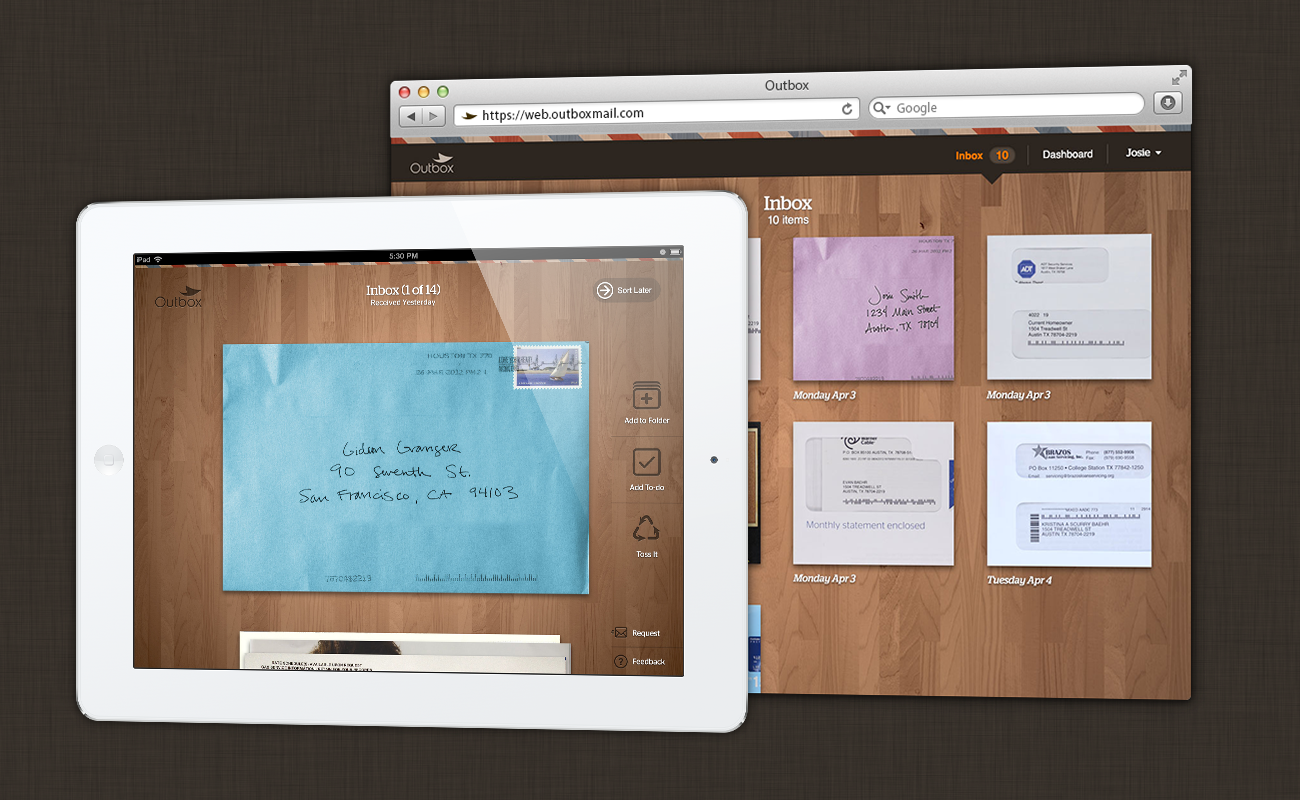
Betting on a struggling system is risky, but Outbox is turning physical mail into digital mail with its new service, currently available only in San Francisco.OUTBOXOutbox on the iPad.

Think of Outbox as Dropbox for physical mail, says cofounder Evan Baehr. Outbox’s “unpostmen” (dressed in bright red) pick up your mail from your mailbox, use a machine to digitize each piece, then store the digital copies in an account you access from the Outbox app. The service is $5 a month. You can have the team deliver anything you need hard copies of and shred the rest.

“A lot of people joke and say, ‘You’re going to digitize my mail and send me a bill electronically—isn’t that called email?’” Baehr says. “People point to a range of digital communication channels, but what we found is that there are actual reasons why people continue to send stuff in the printed form. The explanation why mail still comes to your house is there isn’t a digital alternative that’s attractive enough.”

Security is another concern, but Baehr says Outbox’s “unpostmen” go through rigorous background checks, and the company has identity theft insurance for each customer.OUTBOXOUTBOXOutbox on a smartphone.


The Austin-based startup, founded by Baehr and Harvard Business School classmate Will Davis, kicked off this month with service to residents in San Francisco’s SoMa (South of Market Street) neighborhood, and Baehr says response has been off the charts.

Another company in the digital mail space is Zumbox, which works with businesses that send you mail (such as major banks and utility companies) and stores the mailing pieces in a Digital Mail Box account. Zumbox differs from Outbox in that it doesn’t collect your mail from your mailbox and digitizes only mail from businesses, not people.
Signed, sealed, delivered

A post office that exists to digitize your mail is probably not in our future, says postal strategy consultant John Callan. But you can expect a hybrid of electronic and physical, a transition period with one foot in each realm. The post office is straddling both worlds in its efforts to adopt QR codes and NFC tech, and you can see companies looking to innovate in ways that a large-scale agency like the USPS might not be able to do.

“[Entrepreneurs] do it on the postal platform, which is wonderful,” Callan says. “This is where innovation comes from.”

The postal system has hundreds of years of experience (though the USPS as an agency is just a few decades old), with the structures in place to deliver mail to even the most rural, remote homes in a short time. Startups like Outbox can create a new niche using the post office as a foundation.

Callan is the founder of the annual PostalVision 20/20 conference that brings together big names in the postal industry to discuss its future, but he doesn’t deny that snail mail is marching to its doom. Millennials don’t use the post office the way Baby Boomers do, so their needs will need to be addressed if the system is going to last beyond this generation.

But there is always the nostalgia factor; snail mail is so old-fashioned that it could become cool again—like vinyl records. Even millennials like this writer, often written off as a selfish, tech-obsessed generation, can appreciate tactile, meaningful reminders of the past. Callan says receiving mail at your home is “palpably personal in a way that no electronic medium can be, and will become more appreciated as an art form.”

Thursday, March 14, 2013

What 3-D Printing Could Mean for Small Businesses


What 3-D Printing Could Mean for Small Businesses

BY JOHN PATRICK PULLEN


In formation: The olloclip lens and Shapeways products.
Photo© Ben Alsop

A ball. A cup. A gear. Even an electric car. 3-D printers can't print money, but they can produce prototypes for almost anything else. And as prices for the desktop devices drop, entrepreneurs are seeing them kick out something more: tangible business results.


3-D printing, also known as additive manufacturing, uses technology born of paper printing. But rather than outputting two-dimensional renderings, it makes actual physical objects. There are a few methods. Fused deposition modeling printers push heated material through a tube (much like inkjets), "printing" objects in three dimensions, one layer at a time. Selective laser sintering (SLS) units, meanwhile, operate like laser printers, shining a high-powered beam of light onto a bed of powdered resin, turning it into a hardened material. And stereolithography works similarly to SLS, but with liquid resin.

"There are a ton of companies, from one- and two-person organizations to sub-100-person organizations, that actually make themselves competitive with the 10,000-pound gorilla in their particular marketplace because of the advantages they get with 3-D printing," says Bruce Bradshaw, marketing director of Objet, a 3-D printing provider based in Israel that was merging with Eden Prairie, Minn.-based Stratasys at press time. He says Objet's annual revenue has grown 35 percent over the past three years, driven largely by small- and medium-size business customers. Meanwhile, the average cost of basic 3-D printers has fallen from $200,000 to $15,000.

Huntington Beach, Calif.-based company olloclip has used 3-D printing to make a big name for itself with its little iPhone accessory. The snap-on camera lens has garnered rave reviews and is one of the few peripherals stocked in every Apple Store (not to mention Best Buy and Target). "I can't imagine doing this without owning our own 3-D printer," says CEO Patrick O'Neill.

Olloclip has invested $50,000 in 3-D printing, not only to prototype its own products, but also to create mock-ups of rumored iPhones so that lenses can be designed quickly each time Apple releases a new version. "We can literally sketch an idea in the morning, model it in the afternoon, pop it in the printer and have a sample made that evening," says olloclip design director Chong Pak. Fast turnaround is key for companies in this space; olloclip finished and validated an iPhone 5 version of its product within days of the handset's announcement.

But olloclip's biggest challenge is in fending off counterfeiters in China. Poorly made fake olloclips flood Asian markets. Thanks to 3-D printing, olloclip can keep its computer-aided design files in-house and safe, rather than having samples produced through rapid prototyping service bureaus, which have been known to leak blueprints. "You hope that the people you send the files to are ethical, but you just don't know," O'Neill says. "If you keep it in-house, you don't have to worry about that."

The efficiency of 3-D printing has transformed business for Houston-based ClearCorrect, a maker of invisible braces. Previously it used milling machines to make models of customers' teeth that were thermoformed with a thin, clear plastic to make braces. Only one model could be made before resetting the expensive, high-powered machinery, which often broke down. With 3-D printing, CEO Jarrett Pumphrey discovered, they could run batches of 60 to 70 models at once, taking five minutes each, vs. 13 minutes with milling.

The 130-person company expected a 30 percent sales gain for 2012 and is now using only 4,000 square feet of its facility and three to four people to produce models, rather than the 11,000 square feet and 10 to 15 people needed with the milling machines.

Still, investing in 3-D printing isn't for everyone. That's where providers like New York City-based Shapeways come in. It offers 3-D printing in more than 30 materials--including plastic, glass, metal and ceramic--and an online marketplace where anyone can sell products. It offers 8,000 shop owners a low barrier to entry by charging only for materials used in production, plus a 3.5 percent transaction fee. Clients include designers of jewelry, tech gadgets and housewares; Shapeways enables them to produce and sell their creations in limited numbers but in a cost-effective way. "Our value proposition," says director of marketing Carine Carmy, "is that we can offer the price and quality of what you can buy in a store, and have that still be custom."

Read more stories about: 3-D Printer, Technology, Business idea trends, News and trends

Like this article? Get this issue right now on iPad, Nook or Kindle Fire.

Read more: http://www.entrepreneur.com/article/225446#ixzz2NXe0pGSs

Physicists say they have found a Higgs boson


Physicists say they have found a Higgs boson

Mar 14, 9:28 AM (ET)

By JOHN HEILPRIN


(AP) This 2011 image provided by CERN, shows a real CMS proton-proton collision in which four...
Full Image


GENEVA (AP) - The search is all but over for a subatomic particle that is a crucial building block of the universe.

Physicists announced Thursday they believe they have discovered the subatomic particle predicted nearly a half-century ago, which will go a long way toward explaining what gives electrons and all matter in the universe size and shape.

The elusive particle, called a Higgs boson, was predicted in 1964 to help fill in our understanding of the creation of the universe, which many theorize occurred in a massive explosion known as the Big Bang. The particle was named for Peter Higgs, one of the physicists who proposed its existence, but it later became popularly known as the "God particle."

The discovery would be a strong contender for the Nobel Prize. Last July, scientists at the European Organization for Nuclear Research, or CERN, announced finding a particle they described as Higgs-like, but they stopped short of saying conclusively that it was the same particle or was some version of it.

Scientists have now finished going through the entire set of data.

"The preliminary results with the full 2012 data set are magnificent and to me it is clear that we are dealing with a Higgs boson, though we still have a long way to go to know what kind of Higgs boson it is," said Joe Incandela, a physicist who heads one of the two main teams at CERN, each involving several thousand scientists.

Whether or not it is a Higgs boson is demonstrated by how it interacts with other particles and its quantum properties, CERN said in the statement. After checking, scientists said the data "strongly indicates that it is a Higgs boson."

The results were announced in a statement by the Geneva-based CERN and released at a physics conference in the Italian Alps.

CERN's atom smasher, the $10 billion Large Hadron Collider that lies beneath the Swiss-French border, has been creating high-energy collisions of protons to investigate how the universe came to be the way it is.

The particle's existence helps confirm the theory that objects gain their size and shape when particles interact in an energy field with a key particle, the Higgs boson. The more they attract, so the theory goes, the bigger their mass will be.

Wednesday, March 13, 2013

Debunking the staffing company myths


Debunking the staffing company myths


01.25.2013

Debunking the staffing company myths


It's crucial to use whatever tools you can to help out your job search, whether it's social media to expand your network, online job listings to regularly search for open positions or informational meetings that help you figure out exactly what kind of job you want.

However, one of the most overlooked resources is also one of the most helpful - staffing companies.

According to Business2Community, staffing companies have become instrumental in helping job hunters find a position, as well as giving candidates a potential direction to go in when it comes to the right field or industry. Unfortunately, as demand for temporary work grew during the recession, so too did the number and scale of myths surrounding employment agencies.

One of the most misunderstood aspects of a staffing agency is the kinds of jobs these companies can help you get. While everyone knows these firms are great for entry-level positions, many believe they can't help you move your career further.

This, however, is just plain wrong.

Staffing companies work directly with employers that need all levels of experience, and can help candidates find jobs after years in a particular field. The healthcare, accounting and finance or IT sectors all have huge room for growth, and staffing firms often specialize in placing higher-level jobs in these industries.

Another misconception is that even if you do find a job, a slice of your salary will go to the search firm. Most of the time, a staffing firm will work directly with a business who needs a certain kind of worker, and if the recruiter succeeds in finding that ideal candidate, they are paid by the company that hired you - not you yourself.

If you're worried that even a staffing company doesn't have the power to find an open job amid unemployment that is just under 8 percent, think again. Yes, the unemployment rate isn't ideal, but there are still some 3.7 million jobs out there. Some of them may require a highly specific skill set, but employment agencies typically work with these companies to learn what is most in-demand, the media outlet stated.

According to the Bureau of Labor Statistics, about 7,800 temporary jobs were added in November 2012, and this number remained virtually the same in December 2012. Across the professional and business services sector as a whole, 19,000 jobs were added in December, following 32,000 new jobs in November.