


The Independent
28 December 2005
By Jeremy Laurance, Health Editor
A daily dose of vitamin D could cut the risk of cancers of the breast, colon and ovary by up to a half, a 40-year review of research has found. The evidence for the protective effect of the "sunshine vitamin" is so overwhelming that urgent action must be taken by public health authorities to boost blood levels, say cancer specialists.
A growing body of evidence in recent years has shown that lack of vitamin D may have lethal effects. Heart disease, lung disease, cancer, diabetes, high blood pressure, schizophrenia and multiple sclerosis are among the conditions in which it is believed to play a vital role. The vitamin is also essential for bone health and protects against rickets in children and osteoporosis in the elderly.
Vitamin D is made by the action of sunlight on the skin, which accounts for 90 per cent of the body's supply. But the increasing use of sunscreens and the reduced time spent outdoors, especially by children, has contributed to what many scientists believe is an increasing problem of vitamin D deficiency.
After assessing almost every scientific paper published on the link between vitamin D and cancer since the 1960s, US scientists say that a daily dose of 1,000 international units (25 micrograms) is needed to maintain health. " The high prevalence of vitamin D deficiency combined with the discovery of increased risks of certain types of cancer in those who are deficient, suggest that vitamin D deficiency may account for several thousand premature deaths from colon, breast, ovarian and other cancers annually," they say in the online version of the American Journal of Public Health.
The dose they propose of 1,000IU a day is two-and-a-half times the current recommended level in the US. In the UK, there is no official recommended dose but grey skies and short days from October to March mean 60 per cent of the population has inadequate blood levels by the end of winter.
The UK Food Standards Agency maintains that most people should be able to get all the vitamin D they need from their diet and "by getting a little sun". But the vitamin can only be stored in the body for 60 days.
High rates of heart disease in Scotland have been blamed on the weak sunlight and short summers in the north, leading to low levels of vitamin D. Differences in sunlight may also explain the higher rates of heart disease in England compared with southern Europe. Some experts believe the health benefits of the Mediterranean diet may have as much to do with the sun there as with the regional food.
Countries around the world have begun to modify their warnings about the dangers of sunbathing, as a result of the growing research on vitamin D. The Association of Cancer Councils of Australia acknowledged this year for the first time that some exposure to the sun was healthy.
Australia is one of the world's sunniest countries and has among the highest rates of skin cancer. For three decades it has preached sun avoidance with its "slip, slap, slop" campaign to cover up and use sunscreen. But in a statement in March, the association said: "A balance is required between avoiding an increase in the risk of skin cancer and achieving enough ultraviolet radiation exposure to achieve adequate vitamin D levels." Bruce Armstrong, the professor of public health at Sydney University, said: " It is a revolution."
In the latest study, cancer specialists from the University of San Diego, California, led by Professor Cedric Garland, reviewed 63 scientific papers on the link between vitamin D and cancer published between 1966 and 2004. People living in the north-eastern US, where it is less sunny, and African Americans with darker skins were more likely to be deficient, researchers found. They also had higher cancer rates.
The researchers say their finding could explain why black Americans die sooner from cancer than whites, even after allowing for differences in income and access to care.
Professor Garland said: "A preponderance of evidence from the best observational studies... has led to the conclusion that public health action is needed. Primary prevention of these cancers has been largely neglected, but we now have proof that the incidence of colon, breast and ovarian cancer can be reduced dramatically by increasing the public's intake of vitamin D." Obtaining the necessary level of vitamin D from diet alone would be difficult and sun exposure carries a risk of triggering skin cancer. "The easiest and most reliable way of getting the appropriate amount is from food and a daily supplement," they say.
The cost of a vitamin D supplement is about 4p a day. The UK Food Standards Agency said that taking Vitamin D supplements of up to 1,000IU was " unlikely to cause harm".
What it can do
Heart disease
Vitamin D works by lowering insulin resistance, which is one of the major factors leading to heart disease.
Lung disease
Lung tissue undergoes repair and "remodelling" in life and, since vitamin D influences the growth of a variety of cell types, it may play a role in this lung repair process.
Cancers (breast, colon, ovary, prostate)
Vitamin D is believed to play an important role in regulating the production of cells, a control that is missing in cancer. It has a protective effect against certain cancers by preventing overproduction of cells.
Diabetes
In type 1 diabetes the immune system destroys its own cells. Vitamin D is believed to act as an immunosuppressant. Researchers believe it may prevent an overly aggressive response from the immune system.
High blood pressure
Vitamin D is used by the parathyroid glands that sit on the thyroid gland in the neck. These secrete a hormone that regulates the body's calcium levels. Calcium, in turn, helps to regulate blood pressure, although the mechanism is not yet completely understood.
Schizophrenia
The chance of developing schizophrenia could be linked to how sunny it was in the months before birth. A lack of sunlight can lead to vitamin D deficiency, which scientists believe could alter the growth of a child's brain in the womb.
Multiple sclerosis
Lack of vitamin D leads to limited production of 1.25-dihydroxyvitamin D3, the hormonal form of vitamin D3 which regulates the immune system, creating a risk for MS.
Rickets and osteoporosis
The vitamin strengthens bones, protecting against childhood rickets and osteoporosis in the elderly.
A daily dose of vitamin D could cut the risk of cancers of the breast, colon and ovary by up to a half, a 40-year review of research has found. The evidence for the protective effect of the "sunshine vitamin" is so overwhelming that urgent action must be taken by public health authorities to boost blood levels, say cancer specialists.
A growing body of evidence in recent years has shown that lack of vitamin D may have lethal effects. Heart disease, lung disease, cancer, diabetes, high blood pressure, schizophrenia and multiple sclerosis are among the conditions in which it is believed to play a vital role. The vitamin is also essential for bone health and protects against rickets in children and osteoporosis in the elderly.
Vitamin D is made by the action of sunlight on the skin, which accounts for 90 per cent of the body's supply. But the increasing use of sunscreens and the reduced time spent outdoors, especially by children, has contributed to what many scientists believe is an increasing problem of vitamin D deficiency.
After assessing almost every scientific paper published on the link between vitamin D and cancer since the 1960s, US scientists say that a daily dose of 1,000 international units (25 micrograms) is needed to maintain health. " The high prevalence of vitamin D deficiency combined with the discovery of increased risks of certain types of cancer in those who are deficient, suggest that vitamin D deficiency may account for several thousand premature deaths from colon, breast, ovarian and other cancers annually," they say in the online version of the American Journal of Public Health.
The dose they propose of 1,000IU a day is two-and-a-half times the current recommended level in the US. In the UK, there is no official recommended dose but grey skies and short days from October to March mean 60 per cent of the population has inadequate blood levels by the end of winter.
The UK Food Standards Agency maintains that most people should be able to get all the vitamin D they need from their diet and "by getting a little sun". But the vitamin can only be stored in the body for 60 days.
High rates of heart disease in Scotland have been blamed on the weak sunlight and short summers in the north, leading to low levels of vitamin D. Differences in sunlight may also explain the higher rates of heart disease in England compared with southern Europe. Some experts believe the health benefits of the Mediterranean diet may have as much to do with the sun there as with the regional food.
Countries around the world have begun to modify their warnings about the dangers of sunbathing, as a result of the growing research on vitamin D. The Association of Cancer Councils of Australia acknowledged this year for the first time that some exposure to the sun was healthy.
Australia is one of the world's sunniest countries and has among the highest rates of skin cancer. For three decades it has preached sun avoidance with its "slip, slap, slop" campaign to cover up and use sunscreen. But in a statement in March, the association said: "A balance is required between avoiding an increase in the risk of skin cancer and achieving enough ultraviolet radiation exposure to achieve adequate vitamin D levels." Bruce Armstrong, the professor of public health at Sydney University, said: " It is a revolution."
In the latest study, cancer specialists from the University of San Diego, California, led by Professor Cedric Garland, reviewed 63 scientific papers on the link between vitamin D and cancer published between 1966 and 2004. People living in the north-eastern US, where it is less sunny, and African Americans with darker skins were more likely to be deficient, researchers found. They also had higher cancer rates.
The researchers say their finding could explain why black Americans die sooner from cancer than whites, even after allowing for differences in income and access to care.
Professor Garland said: "A preponderance of evidence from the best observational studies... has led to the conclusion that public health action is needed. Primary prevention of these cancers has been largely neglected, but we now have proof that the incidence of colon, breast and ovarian cancer can be reduced dramatically by increasing the public's intake of vitamin D." Obtaining the necessary level of vitamin D from diet alone would be difficult and sun exposure carries a risk of triggering skin cancer. "The easiest and most reliable way of getting the appropriate amount is from food and a daily supplement," they say.
The cost of a vitamin D supplement is about 4p a day. The UK Food Standards Agency said that taking Vitamin D supplements of up to 1,000IU was " unlikely to cause harm".
What it can do
Heart disease
Vitamin D works by lowering insulin resistance, which is one of the major factors leading to heart disease.
Lung disease
Lung tissue undergoes repair and "remodelling" in life and, since vitamin D influences the growth of a variety of cell types, it may play a role in this lung repair process.
Cancers (breast, colon, ovary, prostate)
Vitamin D is believed to play an important role in regulating the production of cells, a control that is missing in cancer. It has a protective effect against certain cancers by preventing overproduction of cells.
Diabetes
In type 1 diabetes the immune system destroys its own cells. Vitamin D is believed to act as an immunosuppressant. Researchers believe it may prevent an overly aggressive response from the immune system.
High blood pressure
Vitamin D is used by the parathyroid glands that sit on the thyroid gland in the neck. These secrete a hormone that regulates the body's calcium levels. Calcium, in turn, helps to regulate blood pressure, although the mechanism is not yet completely understood.
Schizophrenia
The chance of developing schizophrenia could be linked to how sunny it was in the months before birth. A lack of sunlight can lead to vitamin D deficiency, which scientists believe could alter the growth of a child's brain in the womb.
Multiple sclerosis
Lack of vitamin D leads to limited production of 1.25-dihydroxyvitamin D3, the hormonal form of vitamin D3 which regulates the immune system, creating a risk for MS.
Rickets and osteoporosis
The vitamin strengthens bones, protecting against childhood rickets and osteoporosis in the elderly.

Markets
Latest Hurricane Info: [Link Me to NOAA]
[See The Latest Computer Models]
[DHL WORLD CLOCK]
Miami, FL
Wednesday, December 28, 2005


Monday, December 26, 2005
ABC Bids Farewell to Monday Night Football
Dec 26, 8:23 AM (ET)
EAST RUTHERFORD, N.J. (AP) - If you were ready for some football, it was the place to be for 35 seasons on Monday nights. Tonight, the NFL bids farewell to ABC, with the New England Patriots playing the New York Jets.
The second longest-running series on network TV shifts to ESPN beginning next season.
The series began in 1970, with Keith Jackson handling the play-by-play.
ESPN is paying about $1.1 billion over eight seasons for the Monday night contract.
EAST RUTHERFORD, N.J. (AP) - If you were ready for some football, it was the place to be for 35 seasons on Monday nights. Tonight, the NFL bids farewell to ABC, with the New England Patriots playing the New York Jets.
The second longest-running series on network TV shifts to ESPN beginning next season.
The series began in 1970, with Keith Jackson handling the play-by-play.
ESPN is paying about $1.1 billion over eight seasons for the Monday night contract.
Some more wacky stories...
When his 38-caliber revolver failed to fire at its intend-
ed victim during a holdup in Long Beach, California, would
be robber James Elliot did something that can only inspire
wonder: He peered down the barrel and tried the trigger
again. This time it worked.
************************************************************
The chef at a hotel in Switzerland lost a finger in a meat
cutting machine and, after a little hopping around, submit-
ted a claim to his insurance company. The company, suspect-
ing negligence, sent out one of its men to have a look for
himself. He tried the machine out and lost a finger also.
The chef's claim was approved.
************************************************************
A man who shoveled snow for an hour to clear a space for
his car during a blizzard in Chicago returned with his
vehicle to find a woman had taken the space. Understandably,
he shot her.
************************************************************
After stopping for drinks at an illegal bar, a Zimbabwean
bus driver found that the 20 mental patients he was supposed
to be transporting from Harare to Bulawayo had escaped. Not
wanting to admit his incompetence, the driver went to a
nearby bus-stop and offered everyone waiting there a free
ride. He then delivered the passengers to the mental hospital,
telling the staff that the patients were very excitable and
prone to bizarre fantasies. The deception wasn't discovered
for 3 days.
ed victim during a holdup in Long Beach, California, would
be robber James Elliot did something that can only inspire
wonder: He peered down the barrel and tried the trigger
again. This time it worked.
************************************************************
The chef at a hotel in Switzerland lost a finger in a meat
cutting machine and, after a little hopping around, submit-
ted a claim to his insurance company. The company, suspect-
ing negligence, sent out one of its men to have a look for
himself. He tried the machine out and lost a finger also.
The chef's claim was approved.
************************************************************
A man who shoveled snow for an hour to clear a space for
his car during a blizzard in Chicago returned with his
vehicle to find a woman had taken the space. Understandably,
he shot her.
************************************************************
After stopping for drinks at an illegal bar, a Zimbabwean
bus driver found that the 20 mental patients he was supposed
to be transporting from Harare to Bulawayo had escaped. Not
wanting to admit his incompetence, the driver went to a
nearby bus-stop and offered everyone waiting there a free
ride. He then delivered the passengers to the mental hospital,
telling the staff that the patients were very excitable and
prone to bizarre fantasies. The deception wasn't discovered
for 3 days.
Sunday, December 25, 2005
Roundup of wacky stories
The U.S. Supreme Court has allowed Shawn Gementera, a
California man who pleaded guilty to mail theft, to be
sentenced to spend a day outside a post office wearing a sign
stating: “I stole mail. This is my punishment.”
A 22-year-old named Ronald MacDonald was charged with
stealing money from a Wendy where he worked in
New Hampshire.
Christina Destorges, a 15-year-old Canadian girl with a
peanut allergy, died after kissing her boyfriend, who had
just eaten a peanut snack.
In a study by The Adelaide and Meath Hospital in Dublin,
Ireland, researchers concluded fatter rear ends are causing
drug injections to miss their mark, the buttock muscle, and
longer needles may be required.
From his deathbed, rocker Johnny Ramone
advocated for the nomination of Cat Stevens to the Rock ‘n’
Roll Hall of Fame. A year and half later, Stevens’ name
appeared on the ballot, though he did not win induction.
A Pennsylvania farmer painted his cows, horses and dog
bright orange so hunters wouldn’t mistake them for deer.
California man who pleaded guilty to mail theft, to be
sentenced to spend a day outside a post office wearing a sign
stating: “I stole mail. This is my punishment.”
A 22-year-old named Ronald MacDonald was charged with
stealing money from a Wendy where he worked in
New Hampshire.
Christina Destorges, a 15-year-old Canadian girl with a
peanut allergy, died after kissing her boyfriend, who had
just eaten a peanut snack.
In a study by The Adelaide and Meath Hospital in Dublin,
Ireland, researchers concluded fatter rear ends are causing
drug injections to miss their mark, the buttock muscle, and
longer needles may be required.
From his deathbed, rocker Johnny Ramone
advocated for the nomination of Cat Stevens to the Rock ‘n’
Roll Hall of Fame. A year and half later, Stevens’ name
appeared on the ballot, though he did not win induction.
A Pennsylvania farmer painted his cows, horses and dog
bright orange so hunters wouldn’t mistake them for deer.
Headlines that caught my attention and my annoying comments
MERRY CHRISTMAS Y'ALL
CELEBRITIES REFUSE TO ENTERTAIN TROOPS...
They just love the military. We need another Bob Hope
JOHNNY CASH ON CHENEY'S I-POD...
The VP is hip. I don't even have an I-pod
Feds Monitor Muslims Without Warrants; Search For Nukes...
Awesome. Just don't tell the whole world.
Thwarted al-Qaida plot to kill Bush reported...
They got nothing, we kick ass.
China recruiting U.S. IT grads...
Scary.
Russia deploys new set of strategic nuclear missiles...
Putin is a scary dude. Ex-KGB...I wouldn't trust him
Christmas Eve sales slower than predicted
Predicted by who? Do they have a crystal ball?
Moderate Quake Shakes Pakistan
See, not only us infidels get hit.
Wait a sec for leap into 2006
Oh my god! The Earth is slowing down. Bush better do something about it.
Beware, Barbie! Kids Find Torturing Fun
Kids will be kids.
CHOLESTEROL DRUG MAY BE A LOT MORE
Phenomenal. We may never die. Now we just gotta fix Social Security.
Lawyer demands probe into Saddam torture claim
Why is this even news?
Bush, GOP Downsize Ambitions for 2006
Good. He's got too much in his plate already. Stick to protecting the country
which is his main and most important responsibility. Where in the constitution does it say that the President is responsible for all this other crap.
Vineyard in a box is must-have gift for Italian townies
I want one!!
CELEBRITIES REFUSE TO ENTERTAIN TROOPS...
They just love the military. We need another Bob Hope
JOHNNY CASH ON CHENEY'S I-POD...
The VP is hip. I don't even have an I-pod
Feds Monitor Muslims Without Warrants; Search For Nukes...
Awesome. Just don't tell the whole world.
Thwarted al-Qaida plot to kill Bush reported...
They got nothing, we kick ass.
China recruiting U.S. IT grads...
Scary.
Russia deploys new set of strategic nuclear missiles...
Putin is a scary dude. Ex-KGB...I wouldn't trust him
Christmas Eve sales slower than predicted
Predicted by who? Do they have a crystal ball?
Moderate Quake Shakes Pakistan
See, not only us infidels get hit.
Wait a sec for leap into 2006
Oh my god! The Earth is slowing down. Bush better do something about it.
Beware, Barbie! Kids Find Torturing Fun
Kids will be kids.
CHOLESTEROL DRUG MAY BE A LOT MORE
Phenomenal. We may never die. Now we just gotta fix Social Security.
Lawyer demands probe into Saddam torture claim
Why is this even news?
Bush, GOP Downsize Ambitions for 2006
Good. He's got too much in his plate already. Stick to protecting the country
which is his main and most important responsibility. Where in the constitution does it say that the President is responsible for all this other crap.
Vineyard in a box is must-have gift for Italian townies
I want one!!
Merry Christmas
 May your holidays be filled with peace and happiness in the company of your loved ones, and lets not forget about our brave troops defending our freedom in all parts of the world.
China and Cuba explore socialist development
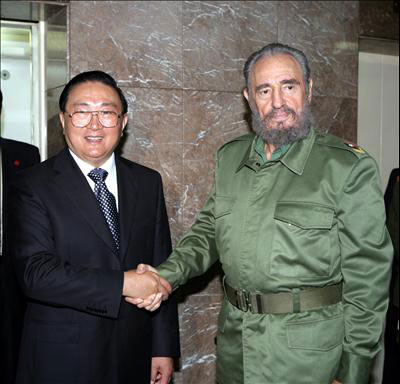
Luo Gan (L), member of the Standing Committee of the Political Bureau of the Communist Party of China Central Committee, shakes hands with Cuban leader Fidel Castro during his visit in Havana, Dec. 20, 2005. Luo began his goodwill visit to Cuba Sunday afternoon at the invitation of the Communist Party of Cuba.
Saturday, December 24, 2005
Fidel Castro Says Bush 'Very Much a Fool'
Dec 23, 9:23 PM (ET)
By ANNE-MARIE GARCIA
(AP) Cuban President Fidel Castro speaks during a Session of the Cuban Parliament, in the Palace of...
Full Image
HAVANA (AP) - Fidel Castro said Friday that the Bush administration was wrong to prohibit Cuba from sending a team to next year's World Baseball Classic.
"He is very much a fool," the Cuban president said of Bush. "He doesn't know who the Cuban baseball players are, or that they are Olympic and world champions. If he knew, he would know something about this country's government."
Castro mentioned the ongoing dispute during the second day of regular sessions of the island's National Assembly.
The U.S. Treasury Department last week rejected the application for Cuba to play in the 16-team tournament scheduled for March 3-20, evidently because of concerns that Castro's government could enjoy financial gain by participating.
Major League Baseball and the Major League Baseball Players Association, which are organizing the tournament, reapplied Thursday to the Treasury Department's Office of Foreign Assets Control. OFAC's permission is required under U.S. laws and regulations governing transactions with Cuba, which has been under an American trade and financial embargo for more than four decades.
In an attempt to eliminate a major concern of the U.S. government, the Cuban Baseball Federation announced Thursday night that any money gained by the national team would be donated to Hurricane Katrina victims.
Cuban baseball "would be willing for the money associated with participation in the classic to go to those displaced by Hurricane Katrina in New Orleans," said the statement read on state television by baseball federation president Carlos Rodriguez.
Cuba is scheduled to play first-round games in San Juan, Puerto Rico, and would remain in San Juan if it advances to the second round.
Antonio Munoz, a businessman who agreed to pay millions of dollars to bring the games to Puerto Rico, thinks the Treasury Department will reverse its decision.
"All efforts are being made to get Cuba to come and participate and I think we will succeed," Munoz told The Associated Press by telephone from New York.
---
Associated Press writer Luis R. Varela in San Juan, Puerto Rico, contributed to this report
By ANNE-MARIE GARCIA

(AP) Cuban President Fidel Castro speaks during a Session of the Cuban Parliament, in the Palace of...
Full Image
HAVANA (AP) - Fidel Castro said Friday that the Bush administration was wrong to prohibit Cuba from sending a team to next year's World Baseball Classic.
"He is very much a fool," the Cuban president said of Bush. "He doesn't know who the Cuban baseball players are, or that they are Olympic and world champions. If he knew, he would know something about this country's government."
Castro mentioned the ongoing dispute during the second day of regular sessions of the island's National Assembly.
The U.S. Treasury Department last week rejected the application for Cuba to play in the 16-team tournament scheduled for March 3-20, evidently because of concerns that Castro's government could enjoy financial gain by participating.
Major League Baseball and the Major League Baseball Players Association, which are organizing the tournament, reapplied Thursday to the Treasury Department's Office of Foreign Assets Control. OFAC's permission is required under U.S. laws and regulations governing transactions with Cuba, which has been under an American trade and financial embargo for more than four decades.
In an attempt to eliminate a major concern of the U.S. government, the Cuban Baseball Federation announced Thursday night that any money gained by the national team would be donated to Hurricane Katrina victims.
Cuban baseball "would be willing for the money associated with participation in the classic to go to those displaced by Hurricane Katrina in New Orleans," said the statement read on state television by baseball federation president Carlos Rodriguez.
Cuba is scheduled to play first-round games in San Juan, Puerto Rico, and would remain in San Juan if it advances to the second round.
Antonio Munoz, a businessman who agreed to pay millions of dollars to bring the games to Puerto Rico, thinks the Treasury Department will reverse its decision.
"All efforts are being made to get Cuba to come and participate and I think we will succeed," Munoz told The Associated Press by telephone from New York.
---
Associated Press writer Luis R. Varela in San Juan, Puerto Rico, contributed to this report

Little Christmas cheer in Cuba; Santa blacklisted
Sun Dec 18, 2005 12:10 PM ET
By Anthony Boadle
HAVANA (Reuters) - Eight years after Communist Cuba restored December 25 as a national holiday in a gesture to Pope John Paul II, there is not much Christmas spirit to show for it.
Christmas decorations are mostly to be found in the more expensive shops and tourist spots, and there is no Santa Claus waving at children on the street corner.
Santa, viewed as a symbol of capitalist consumer society, is banned from storefront displays and can only be seen in private homes.
Cubans have not taken to saying "Merry Christmas," which is not surprising since the atheist state had the holiday crossed off the calendar from 1969 to 1997.
Most use "Happy Holidays" as their greeting and tend to see New Year's Eve as a bigger seasonal holiday. That's when President Fidel Castro's government celebrates the anniversary of the revolution that brought him to power in 1959 and authorities put on street fairs with salsa music and cheap beer.
"Few people say 'Happy Christmas.' The young have no idea what it means," said Carmen Vallejo, a Catholic dissident who works with cancer-stricken children.
Cuba did away with the Christmas holiday in 1969, when Castro's government was trying to bring in a record sugar harvest of 10 million tonnes and needed Cubans to work the extra day cutting cane.
It became a holiday again in 1997, as a show of goodwill before the late pope's historic visit to Cuba one month later. The Church got a temporary boost from the visit, but few of Cuba's 11 million people are practicing Catholics.
This year, for the first time, authorities have allowed a choir of 93 singers from 28 Christian churches to sing Christmas carols in Cuba's main cities and broadcast a performance on state-run television.
At the top of Old Havana's Obispo street there is a large Christmas tree lighting up the Floridita bar, where American author Ernest Hemingway drank frozen daiquiris.
'PEOPLE HAVE NO MONEY'
But residents say there are fewer lights than last year along the colonial-era shopping street, and fewer shoppers.
Stores in Central Havana's main shopping center, Carlos III, are stacked with Chinese goods, from bicycles and tennis rackets to skateboards and roller blades.
Plastic toys made in China are expensive for Cubans, with some selling for $20, more than a doctor's monthly salary.
"There are much fewer shoppers this year. Things are very bad," said Carlos, a parking attendant. "This is the worst year since I started here nine years ago. People have no money."
Many Cubans supplement meager wages with dollars sent by relatives in the United States. But the cash remittances lost 20 percent of their purchasing power after Cuba penalized the U.S. currency a year ago and revalued its own currency.
"There is no Christmas spirit, not even in the churches, because people have no prospects. In the current economic crisis they don't have enough to get by on, let alone celebrate," said Vallejo.
"Sometimes I feel God has turned his back on Cuba."
Cubans got some year-end relief from price cuts ordered by the government for some imported supermarket foods, including jam, raisins, tomato puree and canned tuna and sweet corn.
Christmas cheer or not, Cubans will enjoy a family dinner on Christmas Eve, a tradition akin to Thanksgiving consisting of roast pork and "congri" -- black beans mixed with rice.
© Reuters 2005. All Rights Reserved.
By Anthony Boadle
HAVANA (Reuters) - Eight years after Communist Cuba restored December 25 as a national holiday in a gesture to Pope John Paul II, there is not much Christmas spirit to show for it.
Christmas decorations are mostly to be found in the more expensive shops and tourist spots, and there is no Santa Claus waving at children on the street corner.
Santa, viewed as a symbol of capitalist consumer society, is banned from storefront displays and can only be seen in private homes.
Cubans have not taken to saying "Merry Christmas," which is not surprising since the atheist state had the holiday crossed off the calendar from 1969 to 1997.
Most use "Happy Holidays" as their greeting and tend to see New Year's Eve as a bigger seasonal holiday. That's when President Fidel Castro's government celebrates the anniversary of the revolution that brought him to power in 1959 and authorities put on street fairs with salsa music and cheap beer.
"Few people say 'Happy Christmas.' The young have no idea what it means," said Carmen Vallejo, a Catholic dissident who works with cancer-stricken children.
Cuba did away with the Christmas holiday in 1969, when Castro's government was trying to bring in a record sugar harvest of 10 million tonnes and needed Cubans to work the extra day cutting cane.
It became a holiday again in 1997, as a show of goodwill before the late pope's historic visit to Cuba one month later. The Church got a temporary boost from the visit, but few of Cuba's 11 million people are practicing Catholics.
This year, for the first time, authorities have allowed a choir of 93 singers from 28 Christian churches to sing Christmas carols in Cuba's main cities and broadcast a performance on state-run television.
At the top of Old Havana's Obispo street there is a large Christmas tree lighting up the Floridita bar, where American author Ernest Hemingway drank frozen daiquiris.
'PEOPLE HAVE NO MONEY'
But residents say there are fewer lights than last year along the colonial-era shopping street, and fewer shoppers.
Stores in Central Havana's main shopping center, Carlos III, are stacked with Chinese goods, from bicycles and tennis rackets to skateboards and roller blades.
Plastic toys made in China are expensive for Cubans, with some selling for $20, more than a doctor's monthly salary.
"There are much fewer shoppers this year. Things are very bad," said Carlos, a parking attendant. "This is the worst year since I started here nine years ago. People have no money."
Many Cubans supplement meager wages with dollars sent by relatives in the United States. But the cash remittances lost 20 percent of their purchasing power after Cuba penalized the U.S. currency a year ago and revalued its own currency.
"There is no Christmas spirit, not even in the churches, because people have no prospects. In the current economic crisis they don't have enough to get by on, let alone celebrate," said Vallejo.
"Sometimes I feel God has turned his back on Cuba."
Cubans got some year-end relief from price cuts ordered by the government for some imported supermarket foods, including jam, raisins, tomato puree and canned tuna and sweet corn.
Christmas cheer or not, Cubans will enjoy a family dinner on Christmas Eve, a tradition akin to Thanksgiving consisting of roast pork and "congri" -- black beans mixed with rice.
© Reuters 2005. All Rights Reserved.
IN THE NEWS
Rumsfeld to cut troops in Iraq
What are the dems gonna wine about now?
FBI Monitoring Mosques For Nukes
Must we tell the enemy everything we are doing to foil them GEEEEZZZZZ?
Gee Abdula I guess we must find a new place to hide our dirty bomb.
Alito Defended Use of Domestic Wiretaps
OH MY GOD!!! What a bastard he is.
What are the dems gonna wine about now?
FBI Monitoring Mosques For Nukes
Must we tell the enemy everything we are doing to foil them GEEEEZZZZZ?
Gee Abdula I guess we must find a new place to hide our dirty bomb.
Alito Defended Use of Domestic Wiretaps
OH MY GOD!!! What a bastard he is.
Bolivia's Morales thanks Cuba for example
Posted on 20 Dec 2005 # Reuters
HAVANA: Bolivian President-elect socialist Evo Morales thanked Communist-run Cuba for providing an example for Latin America and vowed to ''liberate'' Bolivia and the region.
''Thank you very much Cuba for showing Latin America and the world how to live with dignity and sovereignty,'' Morales said in a phone interview for a Cuban television show on his Sunday victory at the polls.
''The hour to liberate Bolivia and Latin America has arrived,'' Morales, a former leader of coca farmers and the country's first Indian leader, said.
Morales is an outspoken admirer of Cuban President Fidel Castro and Venezuela's Hugo Chavez, who together are pushing an alternative Latin American integration plan to Washington's Free Trade Zone for the Americas.
Morales, who has called his Movement Towards Socialism a ''nightmare'' for Washington, is also an outspoken critic of Washington's trade plans for the region.
Randy Alonso, moderator of the state-run television show which reflects the views of the government, hailed Morales' victory as an important contribution to Latin American integration and a defeat for Washington.
''Evo's election represents a severe blow to neoliberalism and its backers and a defeat for Washington's aggressive neoconservative policies in the region,'' Alonso said.
Morales' leading rivals conceded defeat when results tabulated by local media Sunday showed him heading for a resounding victory, taking slightly more than 50 per cent of the vote.
With 33 per cent of the official results tallied yesterday, Morales led with 48 per cent to 35 per cent for Jorge Quiroga, a conservative former president. The official count will take several days but based on media calculations Morales' vote tally is expected to remain near 50 per cent.
If Morales gets more than half of the votes in the final result, he will avoid having to face a congressional vote between the two top vote-getters as required by Bolivian law.
Sent by Sr.Cohiba
HAVANA: Bolivian President-elect socialist Evo Morales thanked Communist-run Cuba for providing an example for Latin America and vowed to ''liberate'' Bolivia and the region.
''Thank you very much Cuba for showing Latin America and the world how to live with dignity and sovereignty,'' Morales said in a phone interview for a Cuban television show on his Sunday victory at the polls.
''The hour to liberate Bolivia and Latin America has arrived,'' Morales, a former leader of coca farmers and the country's first Indian leader, said.
Morales is an outspoken admirer of Cuban President Fidel Castro and Venezuela's Hugo Chavez, who together are pushing an alternative Latin American integration plan to Washington's Free Trade Zone for the Americas.
Morales, who has called his Movement Towards Socialism a ''nightmare'' for Washington, is also an outspoken critic of Washington's trade plans for the region.
Randy Alonso, moderator of the state-run television show which reflects the views of the government, hailed Morales' victory as an important contribution to Latin American integration and a defeat for Washington.
''Evo's election represents a severe blow to neoliberalism and its backers and a defeat for Washington's aggressive neoconservative policies in the region,'' Alonso said.
Morales' leading rivals conceded defeat when results tabulated by local media Sunday showed him heading for a resounding victory, taking slightly more than 50 per cent of the vote.
With 33 per cent of the official results tallied yesterday, Morales led with 48 per cent to 35 per cent for Jorge Quiroga, a conservative former president. The official count will take several days but based on media calculations Morales' vote tally is expected to remain near 50 per cent.
If Morales gets more than half of the votes in the final result, he will avoid having to face a congressional vote between the two top vote-getters as required by Bolivian law.
Sent by Sr.Cohiba
Clinton Claimed Authority to Order No-Warrant Searches. Does anyone remember that?
December 20, 2005, 9:46 a.m.
In a little-remembered debate from 1994, the Clinton administration argued that the president has "inherent authority" to order physical searches — including break-ins at the homes of U.S. citizens — for foreign intelligence purposes without any warrant or permission from any outside body. Even after the administration ultimately agreed with Congress's decision to place the authority to pre-approve such searches in the Foreign Intelligence Surveillance Act (FISA) court, President Clinton still maintained that he had sufficient authority to order such searches on his own.
"The Department of Justice believes, and the case law supports, that the president has inherent authority to conduct warrantless physical searches for foreign intelligence purposes," Deputy Attorney General Jamie Gorelick testified before the Senate Intelligence Committee on July 14, 1994, "and that the President may, as has been done, delegate this authority to the Attorney General."
"It is important to understand," Gorelick continued, "that the rules and methodology for criminal searches are inconsistent with the collection of foreign intelligence and would unduly frustrate the president in carrying out his foreign intelligence responsibilities."
Executive Order 12333, signed by Ronald Reagan in 1981, provides for such warrantless searches directed against "a foreign power or an agent of a foreign power."
Reporting the day after Gorelick's testimony, the Washington Post's headline — on page A-19 — read, "Administration Backing No-Warrant Spy Searches." The story began, "The Clinton administration, in a little-noticed facet of the debate on intelligence reforms, is seeking congressional authorization for U.S. spies to continue conducting clandestine searches at foreign embassies in Washington and other cities without a federal court order. The administration's quiet lobbying effort is aimed at modifying draft legislation that would require U.S. counterintelligence officials to get a court order before secretly snooping inside the homes or workplaces of suspected foreign agents or foreign powers."
In her testimony, Gorelick made clear that the president believed he had the power to order warrantless searches for the purpose of gathering intelligence, even if there was no reason to believe that the search might uncover evidence of a crime. "Intelligence is often long range, its exact targets are more difficult to identify, and its focus is less precise," Gorelick said. "Information gathering for policy making and prevention, rather than prosecution, are its primary focus."
The debate over warrantless searches came up after the case of CIA spy Aldrich Ames. Authorities had searched Ames's house without a warrant, and the Justice Department feared that Ames's lawyers would challenge the search in court. Meanwhile, Congress began discussing a measure under which the authorization for break-ins would be handled like the authorization for wiretaps, that is, by the FISA court. In her testimony, Gorelick signaled that the administration would go along a congressional decision to place such searches under the court — if, as she testified, it "does not restrict the president's ability to collect foreign intelligence necessary for the national security." In the end, Congress placed the searches under the FISA court, but the Clinton administration did not back down from its contention that the president had the authority to act when necessary.
— Byron York, NR's White House correspondent, is the author of The Vast Left Wing Conspiracy: The Untold Story of How Democratic Operatives, Eccentric Billionaires, Liberal Activists, and Assorted Celebrities Tried to Bring Down a President — and Why They'll Try Even Harder Next Time.
--------------------------------------------------------------------------------
http://www.nationalreview.com/york/york200512200946.asp
FLASHBACK: CLINTON, CARTER SEARCH 'N SURVEILLANCE WITHOUT COURT ORDER
Bill Clinton Signed Executive Order that allowed Attorney General to do searches without court approval
Clinton, February 9, 1995: "The Attorney General is authorized to approve physical searches, without a court order"
WASH POST, July 15, 1994, "Administration Backing No-Warrant Spy Searches": Extend not only to searches of the homes of U.S. citizens but also -- in the delicate words of a Justice Department official -- to "places where you wouldn't find or would be unlikely to find information involving a U.S. citizen... would allow the government to use classified electronic surveillance techniques, such as infrared sensors to observe people inside their homes, without a court order."
Deputy Attorney General Jamie S. Gorelick, the Clinton administration believes the president "has inherent authority to conduct warrantless searches for foreign intelligence purposes."
Secret searches and wiretaps of Aldrich Ames's office and home in June and October 1993, both without a federal warrant.
Government officials decided in the Ames case that no warrant was required because the searches were conducted for "foreign intelligence purposes," a goal of such vital national security interest that they said it justified extraordinary police powers.
Government lawyers have used this principle to justify other secret searches by U.S. authorities.
"The number of such secret searches conducted each year is classified..."
Jimmy Carter Signed Executive Order on May 23, 1979: "Attorney General is authorized to approve electronic surveillance to acquire foreign intelligence information without a court order."
END
THE WHITE HOUSE
Office of the Press Secretary
________________________________________________________________________
For Immediate Release February 9, 1995
EXECUTIVE ORDER 12949
- - - - - - -
FOREIGN INTELLIGENCE PHYSICAL SEARCHES
By the authority vested in me as President by the Constitution
and the laws of the United States, including sections 302 and 303 of the
Foreign Intelligence Surveillance Act of 1978 ("Act") (50 U.S.C. 1801,
et seq.), as amended by Public Law 103- 359, and in order to provide for
the authorization of physical searches for foreign intelligence purposes
as set forth in the Act, it is hereby ordered as follows:
Section 1. Pursuant to section 302(a)(1) of the Act, the
Attorney General is authorized to approve physical searches, without a
court order, to acquire foreign intelligence information for periods of
up to one year, if the Attorney General makes the certifications
required by that section.
Sec. 2. Pursuant to section 302(b) of the Act, the Attorney
General is authorized to approve applications to the Foreign
Intelligence Surveillance Court under section 303 of the Act to obtain
orders for physical searches for the purpose of collecting foreign
intelligence information.
Sec. 3. Pursuant to section 303(a)(7) of the Act, the following
officials, each of whom is employed in the area of national security or
defense, is designated to make the certifications required by section
303(a)(7) of the Act in support of applications to conduct physical
searches:
(a) Secretary of State;
(b) Secretary of Defense;
(c) Director of Central Intelligence;
(d) Director of the Federal Bureau of
Investigation;
(e) Deputy Secretary of State;
(f) Deputy Secretary of Defense; and
(g) Deputy Director of Central Intelligence.
None of the above officials, nor anyone officially acting in that
capacity, may exercise the authority to make the above certifications,
unless that official has been appointed by the President, by and with
the advice and consent of the Senate.
WILLIAM J. CLINTON
THE WHITE HOUSE,
February 9, 1995.
---------------------------------
EXERCISE OF CERTAIN AUTHORITY RESPECTING ELECTRONIC SURVEILLANCE
EO 12139
23 May 1979
--------------------------------------------------------------------------------
By the authority vested in me as President by Sections 102 and
104 of the Foreign Intelligence Surveillance Act of 1978 (50 U.S.C.
1802 and 1804), in order to provide as set forth in that Act (this
chapter) for the authorization of electronic surveillance for
foreign intelligence purposes, it is hereby ordered as follows:
1-101. Pursuant to Section 102(a)(1) of the Foreign Intelligence
Surveillance Act of 1978 (50 U.S.C. 1802(a)), the Attorney General
is authorized to approve electronic surveillance to acquire foreign
intelligence information without a court order, but only if the
Attorney General makes the certifications required by that Section.
1-102. Pursuant to Section 102(b) of the Foreign Intelligence Act
of 1978 (50 U.S.C. 1802(b)), the Attorney General is authorized to
approve applications to the court having jurisdiction under Section
103 of that Act (50 U.S.C. 1803) to obtain orders for electronic
surveillance for the purpose of obtaining foreign intelligence
information.
1-103. Pursuant to Section 104(a)(7) of the Foreign Intelligence
Surveillance Act of 1978 (50 U.S.C. 1804(a)(7)), the following
officials, each of whom is employed in the area of national
security or defense, is designated to make the certifications
required by Section 104(a)(7) of the Act in support of applications
to conduct electronic surveillance:
(a) Secretary of State.
(b) Secretary of Defense.
(c) Director of Central Intelligence.
(d) Director of the Federal Bureau of Investigation.
(e) Deputy Secretary of State.
(f) Deputy Secretary of Defense.
(g) Deputy Director of Central Intelligence.
None of the above officials, nor anyone officially acting in that
capacity, may exercise the authority to make the above
certifications, unless that official has been appointed by the
President with the advice and consent of the Senate.
1-104. Section 2-202 of Executive Order No. 12036 (set out under
section 401 of this title) is amended by inserting the following at
the end of that section: ''Any electronic surveillance, as defined
in the Foreign Intelligence Surveillance Act of 1978, shall be
conducted in accordance with that Act as well as this Order.''.
1-105. Section 2-203 of Executive Order No. 12036 (set out under
section 401 of this title) is amended by inserting the following at
the end of that section: ''Any monitoring which constitutes
electronic surveillance as defined in the Foreign Intelligence
Surveillance Act of 1978 shall be conducted in accordance with that
Act as well as this Order.''.
Jimmy Carter.
In a little-remembered debate from 1994, the Clinton administration argued that the president has "inherent authority" to order physical searches — including break-ins at the homes of U.S. citizens — for foreign intelligence purposes without any warrant or permission from any outside body. Even after the administration ultimately agreed with Congress's decision to place the authority to pre-approve such searches in the Foreign Intelligence Surveillance Act (FISA) court, President Clinton still maintained that he had sufficient authority to order such searches on his own.
"The Department of Justice believes, and the case law supports, that the president has inherent authority to conduct warrantless physical searches for foreign intelligence purposes," Deputy Attorney General Jamie Gorelick testified before the Senate Intelligence Committee on July 14, 1994, "and that the President may, as has been done, delegate this authority to the Attorney General."
"It is important to understand," Gorelick continued, "that the rules and methodology for criminal searches are inconsistent with the collection of foreign intelligence and would unduly frustrate the president in carrying out his foreign intelligence responsibilities."
Executive Order 12333, signed by Ronald Reagan in 1981, provides for such warrantless searches directed against "a foreign power or an agent of a foreign power."
Reporting the day after Gorelick's testimony, the Washington Post's headline — on page A-19 — read, "Administration Backing No-Warrant Spy Searches." The story began, "The Clinton administration, in a little-noticed facet of the debate on intelligence reforms, is seeking congressional authorization for U.S. spies to continue conducting clandestine searches at foreign embassies in Washington and other cities without a federal court order. The administration's quiet lobbying effort is aimed at modifying draft legislation that would require U.S. counterintelligence officials to get a court order before secretly snooping inside the homes or workplaces of suspected foreign agents or foreign powers."
In her testimony, Gorelick made clear that the president believed he had the power to order warrantless searches for the purpose of gathering intelligence, even if there was no reason to believe that the search might uncover evidence of a crime. "Intelligence is often long range, its exact targets are more difficult to identify, and its focus is less precise," Gorelick said. "Information gathering for policy making and prevention, rather than prosecution, are its primary focus."
The debate over warrantless searches came up after the case of CIA spy Aldrich Ames. Authorities had searched Ames's house without a warrant, and the Justice Department feared that Ames's lawyers would challenge the search in court. Meanwhile, Congress began discussing a measure under which the authorization for break-ins would be handled like the authorization for wiretaps, that is, by the FISA court. In her testimony, Gorelick signaled that the administration would go along a congressional decision to place such searches under the court — if, as she testified, it "does not restrict the president's ability to collect foreign intelligence necessary for the national security." In the end, Congress placed the searches under the FISA court, but the Clinton administration did not back down from its contention that the president had the authority to act when necessary.
— Byron York, NR's White House correspondent, is the author of The Vast Left Wing Conspiracy: The Untold Story of How Democratic Operatives, Eccentric Billionaires, Liberal Activists, and Assorted Celebrities Tried to Bring Down a President — and Why They'll Try Even Harder Next Time.
--------------------------------------------------------------------------------
http://www.nationalreview.com/york/york200512200946.asp
FLASHBACK: CLINTON, CARTER SEARCH 'N SURVEILLANCE WITHOUT COURT ORDER
Bill Clinton Signed Executive Order that allowed Attorney General to do searches without court approval
Clinton, February 9, 1995: "The Attorney General is authorized to approve physical searches, without a court order"
WASH POST, July 15, 1994, "Administration Backing No-Warrant Spy Searches": Extend not only to searches of the homes of U.S. citizens but also -- in the delicate words of a Justice Department official -- to "places where you wouldn't find or would be unlikely to find information involving a U.S. citizen... would allow the government to use classified electronic surveillance techniques, such as infrared sensors to observe people inside their homes, without a court order."
Deputy Attorney General Jamie S. Gorelick, the Clinton administration believes the president "has inherent authority to conduct warrantless searches for foreign intelligence purposes."
Secret searches and wiretaps of Aldrich Ames's office and home in June and October 1993, both without a federal warrant.
Government officials decided in the Ames case that no warrant was required because the searches were conducted for "foreign intelligence purposes," a goal of such vital national security interest that they said it justified extraordinary police powers.
Government lawyers have used this principle to justify other secret searches by U.S. authorities.
"The number of such secret searches conducted each year is classified..."
Jimmy Carter Signed Executive Order on May 23, 1979: "Attorney General is authorized to approve electronic surveillance to acquire foreign intelligence information without a court order."
END
THE WHITE HOUSE
Office of the Press Secretary
________________________________________________________________________
For Immediate Release February 9, 1995
EXECUTIVE ORDER 12949
- - - - - - -
FOREIGN INTELLIGENCE PHYSICAL SEARCHES
By the authority vested in me as President by the Constitution
and the laws of the United States, including sections 302 and 303 of the
Foreign Intelligence Surveillance Act of 1978 ("Act") (50 U.S.C. 1801,
et seq.), as amended by Public Law 103- 359, and in order to provide for
the authorization of physical searches for foreign intelligence purposes
as set forth in the Act, it is hereby ordered as follows:
Section 1. Pursuant to section 302(a)(1) of the Act, the
Attorney General is authorized to approve physical searches, without a
court order, to acquire foreign intelligence information for periods of
up to one year, if the Attorney General makes the certifications
required by that section.
Sec. 2. Pursuant to section 302(b) of the Act, the Attorney
General is authorized to approve applications to the Foreign
Intelligence Surveillance Court under section 303 of the Act to obtain
orders for physical searches for the purpose of collecting foreign
intelligence information.
Sec. 3. Pursuant to section 303(a)(7) of the Act, the following
officials, each of whom is employed in the area of national security or
defense, is designated to make the certifications required by section
303(a)(7) of the Act in support of applications to conduct physical
searches:
(a) Secretary of State;
(b) Secretary of Defense;
(c) Director of Central Intelligence;
(d) Director of the Federal Bureau of
Investigation;
(e) Deputy Secretary of State;
(f) Deputy Secretary of Defense; and
(g) Deputy Director of Central Intelligence.
None of the above officials, nor anyone officially acting in that
capacity, may exercise the authority to make the above certifications,
unless that official has been appointed by the President, by and with
the advice and consent of the Senate.
WILLIAM J. CLINTON
THE WHITE HOUSE,
February 9, 1995.
---------------------------------
EXERCISE OF CERTAIN AUTHORITY RESPECTING ELECTRONIC SURVEILLANCE
EO 12139
23 May 1979
--------------------------------------------------------------------------------
By the authority vested in me as President by Sections 102 and
104 of the Foreign Intelligence Surveillance Act of 1978 (50 U.S.C.
1802 and 1804), in order to provide as set forth in that Act (this
chapter) for the authorization of electronic surveillance for
foreign intelligence purposes, it is hereby ordered as follows:
1-101. Pursuant to Section 102(a)(1) of the Foreign Intelligence
Surveillance Act of 1978 (50 U.S.C. 1802(a)), the Attorney General
is authorized to approve electronic surveillance to acquire foreign
intelligence information without a court order, but only if the
Attorney General makes the certifications required by that Section.
1-102. Pursuant to Section 102(b) of the Foreign Intelligence Act
of 1978 (50 U.S.C. 1802(b)), the Attorney General is authorized to
approve applications to the court having jurisdiction under Section
103 of that Act (50 U.S.C. 1803) to obtain orders for electronic
surveillance for the purpose of obtaining foreign intelligence
information.
1-103. Pursuant to Section 104(a)(7) of the Foreign Intelligence
Surveillance Act of 1978 (50 U.S.C. 1804(a)(7)), the following
officials, each of whom is employed in the area of national
security or defense, is designated to make the certifications
required by Section 104(a)(7) of the Act in support of applications
to conduct electronic surveillance:
(a) Secretary of State.
(b) Secretary of Defense.
(c) Director of Central Intelligence.
(d) Director of the Federal Bureau of Investigation.
(e) Deputy Secretary of State.
(f) Deputy Secretary of Defense.
(g) Deputy Director of Central Intelligence.
None of the above officials, nor anyone officially acting in that
capacity, may exercise the authority to make the above
certifications, unless that official has been appointed by the
President with the advice and consent of the Senate.
1-104. Section 2-202 of Executive Order No. 12036 (set out under
section 401 of this title) is amended by inserting the following at
the end of that section: ''Any electronic surveillance, as defined
in the Foreign Intelligence Surveillance Act of 1978, shall be
conducted in accordance with that Act as well as this Order.''.
1-105. Section 2-203 of Executive Order No. 12036 (set out under
section 401 of this title) is amended by inserting the following at
the end of that section: ''Any monitoring which constitutes
electronic surveillance as defined in the Foreign Intelligence
Surveillance Act of 1978 shall be conducted in accordance with that
Act as well as this Order.''.
Jimmy Carter.
A Tale of Two Rulers

From the Real Cuba
The one on the right ruled Chile for 17 years, from 1973 to 1990.
The one on the left has ruled Cuba for the last 47 years.
After being in power for 15 years, the one on the right allowed a plebiscite to ask the Chilean people if they wanted to continue to be under his rule.
The one on the left has refused to allow a plebiscite or any kind of free elections in 47 years and has named himself 'president for life.'
After losing the plebiscite, the one on the right transferred power to a democratically elected president. The one on the left named his brother to succeed him after he dies.
The one on the right implemented free market policies that laid the groundwork for rapid economic growth and prosperity.
The one on the left took over a country with one of the strongest economies in this Hemisphere and turned it into a basket case.
The one on the right has been prosecuted for his alleged crimes by tribunals in and out of his country.
The one on the left has never been prosecuted for his many crimes, can travel freely and is received by kings, prime ministers and democratically elected presidents as one of their own.
The one on the right has been vilified in many films and documentaries.
The one on the left is revered and idolized by most of Hollywood luminaries.
The one on the right has seen his closest collaborators being sent to jail for crimes committed during his rule.
The one on the left has made millions of dollars printing t-shirts, key chains, postcards, etc. with the effigy of one of his closest collaborators who was responsible for hundreds of crimes.
The one on the right has seen his foreign bank accounts frozen because of illegal transactions.
The one on the left has become one of the world's richest dictators and has full access to all his bank accounts locally and internationally.
Now, guess who is the one who the media always calls a 'dictator' and who is the one that they always refer to as 'president'?
Good News for America - Bad News for the Libs
Booming Economy Boosts Spirits at White House
NewsMax.com Wires
Thursday, Dec. 22, 2005
WASHINGTON -- President Bush, working to retool the Republican message for 2006, is trying to shift public attention to something in short supply during his almost five years in office: a run of good economic figures.
"We're heading into a new year with an economy that is the envy of the world, and we have every reason to be optimistic about our economic future," he told a news conference this week.
Bush's pivot to highlight the economy started at the beginning of the month after a government report revealed that 215,000 jobs had been created in November. Bush went before reporters in the Rose Garden to personally welcome the news. A few days later, he visited a plant in North Carolina to salute those numbers and others, including a third-quarter growth rate that was the highest since early 2004 and a jobless rate that was being kept to 5 percent.
Hoping to keep a spotlight trained on the economy while Bush mounted a concentrated defense of his Iraq policies, the White House press office started issuing a "week ahead" schedule listing upcoming appearances of Commerce Secretary Carlos Gutierrez, Treasury Secretary John Snow and Labor Secretary Elaine Chao. Last week, for instance, House Speaker Dennis Hastert, R-Ill., and Gutierrez teamed up at a suburban Chicago mall to promote holiday-season shopping. On Monday, it was Snow's turn to Christmas-shop for the cameras.
Suddenly, the president's economic team is getting a measure of respect - something it didn't get much of in his first term.
It's beginning to look like "prosperity all across America," Snow told reporters at a year-end news conference to bask in the numbers, exuding an optimism not shared by many Democrats.
Republicans hope talking up the economy will blunt Democratic attempts to use it as an issue in next year's elections and help shift public attention away from casualties in Iraq. Bush continues to face low poll numbers on his handling of the economy, despite the recent improvements.
"Politically, war trumps the economy. But the president has very few things that he can brag about right now," said American University political scientist James Thurber. "He has to point out that the economy is doing very well. It would be foolish not to."
Administration officials can point to the creation of some 1.8 million new jobs in the past year. The economy grew in the July-September quarter at a healthy 4.3 percent, despite Katrina and other hurricanes. Retail sales are up as the holiday season nears.
Democrats point to confusing new Medicare prescription drug choices facing seniors, the threat of huge home heating bills and continued dislocations due to Katrina. "Many families are spending the holidays still in tent cities," said House Democratic leader Nancy Pelosi of California.
David Wyss, chief economist for Standard and Poors in New York, said for now, the economy looks fairly solid, and is likely to remain so through 2006, potentially making it a better 2006 political issue for Republicans than for Democrats.
"Right now it's 'so-far so-good.' The economy's doing much better than we thought it would at this point," Wyss said.
But he said he has some worries - including energy availability and prices and an overvalued dollar that is making U.S. products less attractive overseas.
Some potential problems that economists see lurking:
If gasoline prices spike upward again, as they did in September and October when they pushed above $3 a gallon, consumers could get spooked and cut back on purchases. Soaring home heating bills from a colder-than-normal winter could help depress consumer sentiment.
If the Federal Reserve goes too far in raising interest rates in an effort to fend off inflation, it could stall the economy.
The Fed last week raised short-term rates to a 4 1/2 year high of 4.25 percent. Most economists see one or two additional quarter-point rate hikes - one at Chairman Alan Greenspan's last meeting in January and perhaps another at incoming Chairman Ben Bernanke's first in March.
But inflation persists, and if Bernanke keeps raising rates to demonstrate his credentials as an inflation-fighter, the economy could take a hit.
In Bush's first term, his economic team took a back seat to his national security team, made up of such policy heavyweights as Vice President Dick Cheney, Secretary of State Colin Powell, Defense Secretary Donald Rumsfeld, and Condoleezza Rice, then the national security adviser and now the secretary of state.
Bush fired his first treasury secretary, Paul O'Neill, in December 2002 after O'Neill questioned the need for a fresh round of tax cuts. Lawrence Lindsey was forced out at the same time as director of the president's National Economic Council after suggesting that a war with Iraq and the aftermath could cost $100 billion to $200 billion, which turned out to be a little on the low side.
So far, Snow has proved wrong forecasts of an early retirement and is serving as top cheerleader for Bush's handling of the economy.
Gutierrez, the former chief executive of cereal giant Kellogg, has been taking an active role in stumping for the president's agenda and promoting the recent economic momentum.
"The challenge, of course, is how do you keep it going," the commerce secretary said.
© 2005 Associated Press. All Rights Reserved. This material may not be published, broadcast, rewritten or redistributed.
Sent by Sr.Cohiba
NewsMax.com Wires
Thursday, Dec. 22, 2005
WASHINGTON -- President Bush, working to retool the Republican message for 2006, is trying to shift public attention to something in short supply during his almost five years in office: a run of good economic figures.
"We're heading into a new year with an economy that is the envy of the world, and we have every reason to be optimistic about our economic future," he told a news conference this week.
Bush's pivot to highlight the economy started at the beginning of the month after a government report revealed that 215,000 jobs had been created in November. Bush went before reporters in the Rose Garden to personally welcome the news. A few days later, he visited a plant in North Carolina to salute those numbers and others, including a third-quarter growth rate that was the highest since early 2004 and a jobless rate that was being kept to 5 percent.
Hoping to keep a spotlight trained on the economy while Bush mounted a concentrated defense of his Iraq policies, the White House press office started issuing a "week ahead" schedule listing upcoming appearances of Commerce Secretary Carlos Gutierrez, Treasury Secretary John Snow and Labor Secretary Elaine Chao. Last week, for instance, House Speaker Dennis Hastert, R-Ill., and Gutierrez teamed up at a suburban Chicago mall to promote holiday-season shopping. On Monday, it was Snow's turn to Christmas-shop for the cameras.
Suddenly, the president's economic team is getting a measure of respect - something it didn't get much of in his first term.
It's beginning to look like "prosperity all across America," Snow told reporters at a year-end news conference to bask in the numbers, exuding an optimism not shared by many Democrats.
Republicans hope talking up the economy will blunt Democratic attempts to use it as an issue in next year's elections and help shift public attention away from casualties in Iraq. Bush continues to face low poll numbers on his handling of the economy, despite the recent improvements.
"Politically, war trumps the economy. But the president has very few things that he can brag about right now," said American University political scientist James Thurber. "He has to point out that the economy is doing very well. It would be foolish not to."
Administration officials can point to the creation of some 1.8 million new jobs in the past year. The economy grew in the July-September quarter at a healthy 4.3 percent, despite Katrina and other hurricanes. Retail sales are up as the holiday season nears.
Democrats point to confusing new Medicare prescription drug choices facing seniors, the threat of huge home heating bills and continued dislocations due to Katrina. "Many families are spending the holidays still in tent cities," said House Democratic leader Nancy Pelosi of California.
David Wyss, chief economist for Standard and Poors in New York, said for now, the economy looks fairly solid, and is likely to remain so through 2006, potentially making it a better 2006 political issue for Republicans than for Democrats.
"Right now it's 'so-far so-good.' The economy's doing much better than we thought it would at this point," Wyss said.
But he said he has some worries - including energy availability and prices and an overvalued dollar that is making U.S. products less attractive overseas.
Some potential problems that economists see lurking:
If gasoline prices spike upward again, as they did in September and October when they pushed above $3 a gallon, consumers could get spooked and cut back on purchases. Soaring home heating bills from a colder-than-normal winter could help depress consumer sentiment.
If the Federal Reserve goes too far in raising interest rates in an effort to fend off inflation, it could stall the economy.
The Fed last week raised short-term rates to a 4 1/2 year high of 4.25 percent. Most economists see one or two additional quarter-point rate hikes - one at Chairman Alan Greenspan's last meeting in January and perhaps another at incoming Chairman Ben Bernanke's first in March.
But inflation persists, and if Bernanke keeps raising rates to demonstrate his credentials as an inflation-fighter, the economy could take a hit.
In Bush's first term, his economic team took a back seat to his national security team, made up of such policy heavyweights as Vice President Dick Cheney, Secretary of State Colin Powell, Defense Secretary Donald Rumsfeld, and Condoleezza Rice, then the national security adviser and now the secretary of state.
Bush fired his first treasury secretary, Paul O'Neill, in December 2002 after O'Neill questioned the need for a fresh round of tax cuts. Lawrence Lindsey was forced out at the same time as director of the president's National Economic Council after suggesting that a war with Iraq and the aftermath could cost $100 billion to $200 billion, which turned out to be a little on the low side.
So far, Snow has proved wrong forecasts of an early retirement and is serving as top cheerleader for Bush's handling of the economy.
Gutierrez, the former chief executive of cereal giant Kellogg, has been taking an active role in stumping for the president's agenda and promoting the recent economic momentum.
"The challenge, of course, is how do you keep it going," the commerce secretary said.
© 2005 Associated Press. All Rights Reserved. This material may not be published, broadcast, rewritten or redistributed.
Sent by Sr.Cohiba
Thanks Germany for letting this terrorist scum free
Gonzales Asked Germany to Hold TWA Hijacker
NewsMax.com Wires
Thursday, Dec. 22, 2005
WASHINGTON -- Attorney General Alberto Gonzales personally asked the German government not to release a terrorist accused of killing a Navy diver, but was rebuffed, the Bush administration said Wednesday.
Mohammed Ali Hamadi was freed on parole by German authorities after serving 19 years of a life sentence for the 1985 hijacking of a TWA plane during which a U.S. Navy diver was killed. The 17-day ordeal riveted the United States and brought Middle East terrorism home for many Americans.
"We did, at senior levels at the U.S. government, contact the German authorities to emphasize that we thought it was important that he serve out his entire term, but we did so with a full understanding that under German law it was highly likely that he was going to be released," said State Department spokesman Sean McCormack.
A U.S. official, speaking on condition of anonymity because discussions are ongoing, said the United States believes Hamadi was released from temporary custody in Lebanon and has disappeared.
Lebanon is an emerging U.S. ally in the volatile Middle East, with a new democratically elected government and growing diplomatic and economic ties with the West. Lebanon's Syrian-allied prime minister remains in power, however, and the country is still largely defined by sectarian politics.
The United States has no extradition treaty with Lebanon.
"We have been in contact with them on the issue," McCormack said. "And at this point I think what I can assure anybody who's listening, including Mr. Hamadi, is that we will track him down. We will find him. And we will bring him to justice in the United States for what he's done."
Lebanese authorities questioned whether they have any grounds to hand over Hamadi.
"They (U.S. authorities) could have asked Germany to hand him over to the United States. Why are they asking us?" Prime Minister Fuad Saniora told reporters Wednesday.
The United States had sought to prosecute Hamadi when he was arrested in Germany in 1987, but the Germans would not turn him over. The United States has periodically asked that Hamadi not be released early, requests that intensified as his potential parole date approached.
Gonzales contacted his German counterpart within the last month, McCormack said. A Justice Department official confirmed Gonzales' involvement but could not provide an exact date or details of the conversation. The official spoke on condition of anonymity because the discussion was private.
The State Department said the United States did not renew its extradition request to Germany as Hamadi neared release because German law would not permit him to be handed over for prosecution for a crime already prosecuted in German courts.
Trans World Airlines Flight 847, with 145 passengers and nine crew members, was flying from Athens to Rome on June 14, 1985, when it was hijacked by Shiite Muslim militants demanding the release of hundreds of Lebanese from Israeli jails.
The plane was forced to crisscross the Mediterranean from Lebanon to Algeria, landing in Beirut three times before it was finally allowed to remain there. Navy diver Robert Dean Stethem, 23, was killed and his body dumped on the Beirut tarmac.
© 2005 Associated Press. All Rights Reserved. This material may not be published, broadcast, rewritten or redistributed.
Sent by Sr.Cohiba
NewsMax.com Wires
Thursday, Dec. 22, 2005
WASHINGTON -- Attorney General Alberto Gonzales personally asked the German government not to release a terrorist accused of killing a Navy diver, but was rebuffed, the Bush administration said Wednesday.
Mohammed Ali Hamadi was freed on parole by German authorities after serving 19 years of a life sentence for the 1985 hijacking of a TWA plane during which a U.S. Navy diver was killed. The 17-day ordeal riveted the United States and brought Middle East terrorism home for many Americans.
"We did, at senior levels at the U.S. government, contact the German authorities to emphasize that we thought it was important that he serve out his entire term, but we did so with a full understanding that under German law it was highly likely that he was going to be released," said State Department spokesman Sean McCormack.
A U.S. official, speaking on condition of anonymity because discussions are ongoing, said the United States believes Hamadi was released from temporary custody in Lebanon and has disappeared.
Lebanon is an emerging U.S. ally in the volatile Middle East, with a new democratically elected government and growing diplomatic and economic ties with the West. Lebanon's Syrian-allied prime minister remains in power, however, and the country is still largely defined by sectarian politics.
The United States has no extradition treaty with Lebanon.
"We have been in contact with them on the issue," McCormack said. "And at this point I think what I can assure anybody who's listening, including Mr. Hamadi, is that we will track him down. We will find him. And we will bring him to justice in the United States for what he's done."
Lebanese authorities questioned whether they have any grounds to hand over Hamadi.
"They (U.S. authorities) could have asked Germany to hand him over to the United States. Why are they asking us?" Prime Minister Fuad Saniora told reporters Wednesday.
The United States had sought to prosecute Hamadi when he was arrested in Germany in 1987, but the Germans would not turn him over. The United States has periodically asked that Hamadi not be released early, requests that intensified as his potential parole date approached.
Gonzales contacted his German counterpart within the last month, McCormack said. A Justice Department official confirmed Gonzales' involvement but could not provide an exact date or details of the conversation. The official spoke on condition of anonymity because the discussion was private.
The State Department said the United States did not renew its extradition request to Germany as Hamadi neared release because German law would not permit him to be handed over for prosecution for a crime already prosecuted in German courts.
Trans World Airlines Flight 847, with 145 passengers and nine crew members, was flying from Athens to Rome on June 14, 1985, when it was hijacked by Shiite Muslim militants demanding the release of hundreds of Lebanese from Israeli jails.
The plane was forced to crisscross the Mediterranean from Lebanon to Algeria, landing in Beirut three times before it was finally allowed to remain there. Navy diver Robert Dean Stethem, 23, was killed and his body dumped on the Beirut tarmac.
© 2005 Associated Press. All Rights Reserved. This material may not be published, broadcast, rewritten or redistributed.
Sent by Sr.Cohiba
Subscribe to:
Posts (Atom)