


CALVIN AND HOBBES -- AND MUHAMMAD By Ann Coulter
Wed Feb 8, 8:16 PM ET
As my regular readers know, I've long been skeptical of the "Religion of Peace" moniker for Muslims -- for at least 3,000 reasons right off the top of my head. I think the evidence is going my way this week.
The culture editor of a newspaper in Denmark suspected writers and cartoonists were engaging in self-censorship when it came to the Religion of Peace. It was subtle things, like a Danish comedian's statement, paraphrased by The New York Times, "that he had no problem urinating on the Bible but that he would not dare do the same to the Quran."
So, after verifying that his life insurance premiums were paid up, the editor expressly requested cartoons of Muhammad from every cartoonist with a Danish cartoon syndicate. Out of 40 cartoonists, only 10 accepted the invitation, most of them submitting utterly neutral drawings with no political content whatsoever.
But three cartoons made political points.
One showed Muhammad turning away suicide bombers from the gates of heaven, saying "Stop, stop -- we ran out of virgins!" -- which I believe was a commentary on Muslims' predilection for violence. Another was a cartoon of Muhammad with horns, which I believe was a commentary on Muslims' predilection for violence. The third showed Muhammad with a turban in the shape of a bomb, which I believe was an expression of post-industrial ennui in a secular -- oops, no, wait: It was more of a commentary on Muslims' predilection for violence.
In order to express their displeasure with the idea that Muslims are violent, thousands of Muslims around the world engaged in rioting, arson, mob savagery, flag-burning, murder and mayhem, among other peaceful acts of nonviolence.
Muslims are the only people who make feminists seem laid-back.
The little darlings brandish placards with typical Religion of Peace slogans, such as: "Behead Those Who Insult Islam," "Europe, you will pay, extermination is on the way" and "Butcher those who mock Islam." They warn Europe of their own impending 9/11 with signs that say: "Europe: Your 9/11 will come" -- which is ironic, because they almost had me convinced the Jews were behind the 9/11 attack.
The rioting Muslims claim they are upset because Islam prohibits any depictions of Muhammad -- though the text is ambiguous on beheadings, suicide bombings and flying planes into skyscrapers.
The belief that Islam forbids portrayals of Muhammad is recently acquired. Back when Muslims created things, rather than blowing them up, they made paintings, frescoes, miniatures and prints of Muhammad.
But apparently the Quran is like the Constitution: It's a "living document," capable of sprouting all-new provisions at will. Muslims ought to start claiming the Quran also prohibits indoor plumbing, to explain their lack of it.
Other interpretations of the Quran forbid images of humans or animals, which makes even a child's coloring book blasphemous. That's why the Taliban blew up those priceless Buddhist statues, bless their innocent, peace-loving little hearts.
Largely unnoticed in this spectacle is the blinding fact that one nation is missing from the long list of Muslim countries (by which I mean France and England) with hundreds of crazy Muslims experiencing bipolar rage over some cartoons: Iraq. Hey -- maybe this democracy thing does work! The barbaric behavior of Europe's Muslims suggests that the European welfare state may not be attracting your top-notch Muslims.
Making the rash assumption for purposes of discussion that Islam is a religion and not a car-burning cult, even a real religion can't go bossing around other people like this.
Catholics aren't short on rules, but they couldn't care less if non-Catholics use birth control. Conservative Jews have no interest in forbidding other people from mixing meat and dairy. Protestants don't make a peep about other people eating food off one another's plates. (Just stay away from our plates -- that's disgusting.)
But Muslims think they can issue decrees about what images can appear in newspaper cartoons. Who do they think they are, liberals?

Markets
Latest Hurricane Info: [Link Me to NOAA]
[See The Latest Computer Models]
[DHL WORLD CLOCK]
Miami, FL
Saturday, February 11, 2006


Sunday, February 05, 2006

Monday, January 23, 2006
In the news...
YAHOO, MS: No personal data surrendered To Feds...
RNC Has More Than Six Times As Much Cash As The DNC...
MAG: Bush Team Said To Be Worried About Photos Of President With Abramoff...
Canadian Liberals face loss after 12 years in power...
Michael Moore weighs in...
Border security playing role in election...
Rice says time for talking with Iran is over...
Tehran Threatens Full Uranium Enrichment...
Leader sees “final war” between Muslims, West...
RNC Has More Than Six Times As Much Cash As The DNC...
MAG: Bush Team Said To Be Worried About Photos Of President With Abramoff...
Canadian Liberals face loss after 12 years in power...
Michael Moore weighs in...
Border security playing role in election...
Rice says time for talking with Iran is over...
Tehran Threatens Full Uranium Enrichment...
Leader sees “final war” between Muslims, West...
The anti-anti-American
The anti-anti-American Boston Globe - Jan 22, 2006A French philosopher retraces Tocqueville's steps to see if America is really as bad as his countrymen say it is. By Laura Winters. Editorial Observer Democracy in America, Then and Now, a Struggle ... New York Times America's unlikely defender Salon
Thursday, January 05, 2006
Hugo Chavez doll outsells Spiderman - Superman

Venezuela's top-selling toy this Christmas was an action doll figure of President Hugo Chavez. Different versions of the doll include one in a combat uniform and one another which reads one of the president's anti-American speeches.
A spokesman for one of the country's leading toy shops told Estado de Sao Paulo: "It was amazing, the Hugo Chavez doll sold a lot more than Spiderman, Superman or any other toy this year.
"Our president really is our favourite hero!"
Comment by Pete: UNNNNNNBELIEVABLE!!!!
Original Article at: ananova.com
Sent by Sr.Cohiba
Tuesday, January 03, 2006
Monday, January 02, 2006
FIU to build Medical School - Thanks to Donor
This past Sunday, The Miami Herald published a profile of Herb and Nicole Wertheim and their family foundation's recent $20 million gift to FIU to help bring a public medical school to South Florida.
Below is the complete newspaper article and here is a link to the story on herald.com: http://www.miami.com/mld/miamiherald/news/front/13378561.htm
FIU'S BIGGEST DONOR WAS A BOY WITH HOLEY SHOES
The man who pledged FIU's single largest donation is filled with ideas and energy, yet he hasn't forgotten the tattered shoes of his boyhood.
BY TASKER
gtasker@herald.com
Herbert Wertheim is an inventor, pilot, philosopher, philanthropist and university trustee. He also is a charming storyteller. ''Telling stories produces endorphins in me,'' he said. ``I love my life.''
As the self-made multimillionaire optometrist/entrepreneur who has pledged $20 million to Florida International University for its proposed medical school, his fast-paced stories reflect a many-faceted man.
He has worked his way up from poverty to enormous wealth, from a school boy ashamed of dirty feet because of holes in his sneakers to a man with 100 pairs of ''good stylish shoes'' in the closets of his seven homes.
He arises at 3:30 or 4 in the morning to read five newspapers, take an online course in whatever has snared his interest or work on the design of new eyeglass lenses. His electrons, neutrons and protons are positively charged enough to carry him at the speed of light through the day, but at the dinner table he occasionally nods off for 10 or 15 minutes -- a quirky habit that his family and friends have come to expect -- to awaken recharged.
Not bad for a 67-year-old man who never got a high school diploma because, hampered by dyslexia, he had such trouble reading as a child.
It was dyslexia, in part, that led him to many of his discoveries. As an optometrist-inventor, he pioneered dyes for plastic sunglass lenses and, in a parallel serendipity, found that tinted lenses can be used to help dyslexics read better.
Today, a whole line of lens tints can be prescribed by eye doctors for dyslexia because of Wertheim's work. More recently, he has created lenses to slow the progress of macrodegeneration of the eye.
But it was his tints for sunglasses and lenses that revolutionized eye wear. He invented a tint to protect eyes against ultraviolet light. His business, BPI, which stands for Brain Power Inc., has captured between 70 percent and 85 percent of the world market in plastic lens tints, chemicals and instruments. He holds more than 100 patents and trademarks.
BPI, located in Miami and just outside of London in Rugby , , still is privately held, and Wertheim won't divulge its worth. Nor, he claims, does he know how wealthy he is. ''But I can keep feeding us,'' he said. ``I'm worth enough so I can make significant gifts in the future.''
For the present, Wertheim's $20 million pledge to FIU's proposed medical school is the largest in FIU history.
When FIU President Modesto ''Mitch'' Maidique met Wertheim 20 years ago in a delegation of businessmen visiting to offer financial advice to President Raul Alfonsine, he said, he invited Wertheim to join the FIU Foundation.
''There was very good chemistry between us,'' Maidique said. ``He has tremendous respect for education, science and the process of invention.''
In the 1990s, the Wertheims paid for the construction of the biology department's glass conservatory and computer-wired classroom next to it, and they stepped in with more than $1 million when the school ran out of money to finish the performing arts center. That building not only bears the Wertheim name, it houses an enormous pipe organ given in memory of Wertheim's mother, Sydell Ida.
''He has vision about a lot of things,'' said Nicole Wertheim, his wife of 36 years.
Vision is quite literally Wertheim's stock, trade and gift.
In many ways, struggles to tame words on a page made irregular by dyslexia shaped his life, as did the drive to move away from a place where the shower was outside and the toilet downstairs in his father's Hollywood bakery, the now-defunct Beach Bakery, next to the Hollywood Beach Hotel.
When he was unable to master his school work, Wertheim built up a childhood history of truancy and running away from home. Some of his stories give little glimpses into a boy escaping to the Everglades and gigging frogs, a kid living by his wits but eventually hauled before a juvenile judge who gave him two choices: reformatory or the Navy.
He chose the Navy, where he learned he wasn't stupid, and he found his love of engineering.
On a recent December day, with his wife by his side because he has spent fewer than 50 days away from her in their 36-year marriage, he indulged himself in spinning stories from morning until dusk, telling his history and outlining his vision for FIU's proposed school of medicine.
''Being with Herb is like being on a rocketship of ideas,'' Maidique said. ``He himself will tell you that most of the ideas aren't any good, but he comes out with gems on a regular schedule. It could be anything from landscaping, to the curriculum, to the medical school, to where we spend our money. Anything.''
Dr. Jeffrey Horstmyer, chief of neurology at Mercy Hospital and chairman of FIU's Council of 100 that promotes the school through business and cultural connections, said Wertheim's ideas about the proposed medical school are widely shared. ''The idea of preventive medicine resonates with everyone,'' he said.
Wertheim foresees a school of medicine that will train local students for local work, a school that takes a holistic approach to medicine with programs for nutrition, preventive medicine, a school of public health, and a dozen community medical centers.
The medical school is no sure thing.
The state's Board of Governors, which oversees the state university system, will consider approval of the school in March.
He proposes a 24-hours-a-day television channel devoted to healthcare to be beamed out from the school and hopes the medical school would become a National Cancer Center added to those already funded by the National Institutes of Health.
WORKING FOR CHANGE
He finds plenty of things to fault about the current healthcare system, but pulls himself up short: ``I don't think it's enough to bitch; you have to change the system.''
He has devoted his life to changing things; that's how he spends his capital, which to him is time.
``What defines us as humans is what we do with our time. It's our common denominator. We have a finite amount.''
He and his wife ``try to go where no one else has been before so we can make a difference.''
Such pronouncements do not make him less approachable or likeable.
He has sufficient memories of the long climb up to make him almost gleeful about his view from the top, and he shares the missteps as well as the leaps forward.
During his impoverished childhood, when his German immigrant father ran the bakery, he was allowed one pair of shoes a year.
''I couldn't have shoes that cost more than $5,'' he said.
One year when he was in elementary school, his high-top sneakers developed holes in the sides. At school, he was asked to remove his shoes from his sockless feet to be weighed. ``I had to take my shoes off, and my feet were dirty. I remember all the kids saying I was dirty. I ran away and hid at a church until dark. It marked me. It was one of the saddest moments of my life.''
''That's why we have to be very sensitive with children,'' Nicole Wertheim said. ``And that's why he's so motivated.''
After four years in the Navy, Wertheim returned to Miami and briefly sold Collier encyclopedias door-to-door before getting into Brevard Community College . He had to take a Florida high school equivalency test before he could graduate from college.
Summers, he took physics courses at the University of Florida and worked for General Dynamics and NASA. He earned bachelor of science and doctor of optometry degrees from Southern College of Optometry in Tennessee .
Bob Breier, an attorney who helped Wertheim set up his foundation, said that in the early years Wertheim was ``probably the most unsuccessful optometrist in Miami .''
His wife had left Paris to travel and find a more exciting life.
After they married, the couple lived on a 22- by 52-foot houseboat with leopard-print walls, a red kitchen sink and black countertops but no other appliances.
''Very '60s,'' Nicole Wertheim said.
A broom from Sears served as a place to hang clothes.
At his office, Nicole Wertheim worked as his bookkeeper and assistant.
''She wrote everything in French,'' Wertheim said. 'I said, `Nicole, this is true job security' because I couldn't [read] anything in French.''
$2,000 CHECK
When a friend in 1969 told Wertheim about 2 ½ acres on Killian Drive for $16,000, he rushed over and gave the real estate agent a check for $2,000 without seeing the property.
''I no more had $2,000 than the man in the moon,'' he said. 'I went to University National Bank and said to my banker, `Tom, I might be going to jail.' ''
A signature loan saw him through. The Wertheims then set about building their own house. They rented a crane on the weekends for $25 an hour. ``I'd pick up the crane and drive it, and Nicole would follow in the car . . .''
''At 20 miles an hour,'' she joined in.
''And we put the steel in place,'' he said.
Eventually, the house with a 135-foot conservatory was sold for a house in Gables Estates.
Fortunes improved when Wertheim got into the business of tinting glasses and sunglasses -- and inventing the machines and chemicals.
Early on, he sold tint formulas to another company for $20,000 and the promise of royalties.
With the $20,000 he bought a sailboat, but the royalties never appeared. So in 1971, he started Brain Power Inc. as a consulting business to optometrists.
He discovered how damaging ultraviolet rays from sunlight can be to eyesight, so he developed UV 400 Tint, which today deflects UV rays in glasses around the world. He invented and patented machines to apply the tints, clean contact lenses and clean even sensitive equipment for NASA.
Savvy investments with the success of BPI have made Wertheim a 15 percent stockholder in Heico, the Hollywood aerospace and engineering company, a major stockholder in Ivax, the generic pharmaceuticals concern, and in other technology companies.
The sailboat has morphed into a yacht called Brain Power, and Wertheim is on the board of directors of Sea Keepers, a nonprofit group of yacht owners that collects scientific data on their boats for universities and governments.
AGRARIAN LIFE
A ranch purchased 20 years ago in Eagle Valley, Colo. , was to give his daughters Erica and Vanessa a taste of agrarian life. The girls learned how to grow vegetables and take care of animals.
When they began skiing, the family bought a house in Vail.
The Wertheims ate dinner with their girls every night at 7. Breakfast, too, was a family activity, with beds being made beforehand. Wertheim always cooks lunch and dinner, and these days many meals include lycopene-loaded tomatoes and curry for ``cognitive agility.''
Erica and Vanessa, in their early 30s, are married and live in California , and the Wertheims spend a lot of time traveling. Their jet-setting life began in 1991 when, as a shareholder in American Airlines, Wertheim bought a $750,000 pass for unlimited first-class tickets for the rest of their lives.
'I'll say to Nicole, `Would you like to go to Paris ?' and we write our own ticket,'' he said.
Both Wertheims are pilots. For his 70th birthday, with his wife's OK, Wertheim is giving himself a private jet so sleekly designed it looks like an F-16 fighter. He carries its picture in a Blackberry.
''People ask me how to become a multimillionaire,'' he said. ``My response is first you make a million dollars. Then you do it again and again and again.
Below is the complete newspaper article and here is a link to the story on herald.com: http://www.miami.com/mld/miamiherald/news/front/13378561.htm
FIU'S BIGGEST DONOR WAS A BOY WITH HOLEY SHOES
The man who pledged FIU's single largest donation is filled with ideas and energy, yet he hasn't forgotten the tattered shoes of his boyhood.
BY TASKER
gtasker@herald.com
Herbert Wertheim is an inventor, pilot, philosopher, philanthropist and university trustee. He also is a charming storyteller. ''Telling stories produces endorphins in me,'' he said. ``I love my life.''
As the self-made multimillionaire optometrist/entrepreneur who has pledged $20 million to Florida International University for its proposed medical school, his fast-paced stories reflect a many-faceted man.
He has worked his way up from poverty to enormous wealth, from a school boy ashamed of dirty feet because of holes in his sneakers to a man with 100 pairs of ''good stylish shoes'' in the closets of his seven homes.
He arises at 3:30 or 4 in the morning to read five newspapers, take an online course in whatever has snared his interest or work on the design of new eyeglass lenses. His electrons, neutrons and protons are positively charged enough to carry him at the speed of light through the day, but at the dinner table he occasionally nods off for 10 or 15 minutes -- a quirky habit that his family and friends have come to expect -- to awaken recharged.
Not bad for a 67-year-old man who never got a high school diploma because, hampered by dyslexia, he had such trouble reading as a child.
It was dyslexia, in part, that led him to many of his discoveries. As an optometrist-inventor, he pioneered dyes for plastic sunglass lenses and, in a parallel serendipity, found that tinted lenses can be used to help dyslexics read better.
Today, a whole line of lens tints can be prescribed by eye doctors for dyslexia because of Wertheim's work. More recently, he has created lenses to slow the progress of macrodegeneration of the eye.
But it was his tints for sunglasses and lenses that revolutionized eye wear. He invented a tint to protect eyes against ultraviolet light. His business, BPI, which stands for Brain Power Inc., has captured between 70 percent and 85 percent of the world market in plastic lens tints, chemicals and instruments. He holds more than 100 patents and trademarks.
BPI, located in Miami and just outside of London in Rugby , , still is privately held, and Wertheim won't divulge its worth. Nor, he claims, does he know how wealthy he is. ''But I can keep feeding us,'' he said. ``I'm worth enough so I can make significant gifts in the future.''
For the present, Wertheim's $20 million pledge to FIU's proposed medical school is the largest in FIU history.
When FIU President Modesto ''Mitch'' Maidique met Wertheim 20 years ago in a delegation of businessmen visiting to offer financial advice to President Raul Alfonsine, he said, he invited Wertheim to join the FIU Foundation.
''There was very good chemistry between us,'' Maidique said. ``He has tremendous respect for education, science and the process of invention.''
In the 1990s, the Wertheims paid for the construction of the biology department's glass conservatory and computer-wired classroom next to it, and they stepped in with more than $1 million when the school ran out of money to finish the performing arts center. That building not only bears the Wertheim name, it houses an enormous pipe organ given in memory of Wertheim's mother, Sydell Ida.
''He has vision about a lot of things,'' said Nicole Wertheim, his wife of 36 years.
Vision is quite literally Wertheim's stock, trade and gift.
In many ways, struggles to tame words on a page made irregular by dyslexia shaped his life, as did the drive to move away from a place where the shower was outside and the toilet downstairs in his father's Hollywood bakery, the now-defunct Beach Bakery, next to the Hollywood Beach Hotel.
When he was unable to master his school work, Wertheim built up a childhood history of truancy and running away from home. Some of his stories give little glimpses into a boy escaping to the Everglades and gigging frogs, a kid living by his wits but eventually hauled before a juvenile judge who gave him two choices: reformatory or the Navy.
He chose the Navy, where he learned he wasn't stupid, and he found his love of engineering.
On a recent December day, with his wife by his side because he has spent fewer than 50 days away from her in their 36-year marriage, he indulged himself in spinning stories from morning until dusk, telling his history and outlining his vision for FIU's proposed school of medicine.
''Being with Herb is like being on a rocketship of ideas,'' Maidique said. ``He himself will tell you that most of the ideas aren't any good, but he comes out with gems on a regular schedule. It could be anything from landscaping, to the curriculum, to the medical school, to where we spend our money. Anything.''
Dr. Jeffrey Horstmyer, chief of neurology at Mercy Hospital and chairman of FIU's Council of 100 that promotes the school through business and cultural connections, said Wertheim's ideas about the proposed medical school are widely shared. ''The idea of preventive medicine resonates with everyone,'' he said.
Wertheim foresees a school of medicine that will train local students for local work, a school that takes a holistic approach to medicine with programs for nutrition, preventive medicine, a school of public health, and a dozen community medical centers.
The medical school is no sure thing.
The state's Board of Governors, which oversees the state university system, will consider approval of the school in March.
He proposes a 24-hours-a-day television channel devoted to healthcare to be beamed out from the school and hopes the medical school would become a National Cancer Center added to those already funded by the National Institutes of Health.
WORKING FOR CHANGE
He finds plenty of things to fault about the current healthcare system, but pulls himself up short: ``I don't think it's enough to bitch; you have to change the system.''
He has devoted his life to changing things; that's how he spends his capital, which to him is time.
``What defines us as humans is what we do with our time. It's our common denominator. We have a finite amount.''
He and his wife ``try to go where no one else has been before so we can make a difference.''
Such pronouncements do not make him less approachable or likeable.
He has sufficient memories of the long climb up to make him almost gleeful about his view from the top, and he shares the missteps as well as the leaps forward.
During his impoverished childhood, when his German immigrant father ran the bakery, he was allowed one pair of shoes a year.
''I couldn't have shoes that cost more than $5,'' he said.
One year when he was in elementary school, his high-top sneakers developed holes in the sides. At school, he was asked to remove his shoes from his sockless feet to be weighed. ``I had to take my shoes off, and my feet were dirty. I remember all the kids saying I was dirty. I ran away and hid at a church until dark. It marked me. It was one of the saddest moments of my life.''
''That's why we have to be very sensitive with children,'' Nicole Wertheim said. ``And that's why he's so motivated.''
After four years in the Navy, Wertheim returned to Miami and briefly sold Collier encyclopedias door-to-door before getting into Brevard Community College . He had to take a Florida high school equivalency test before he could graduate from college.
Summers, he took physics courses at the University of Florida and worked for General Dynamics and NASA. He earned bachelor of science and doctor of optometry degrees from Southern College of Optometry in Tennessee .
Bob Breier, an attorney who helped Wertheim set up his foundation, said that in the early years Wertheim was ``probably the most unsuccessful optometrist in Miami .''
His wife had left Paris to travel and find a more exciting life.
After they married, the couple lived on a 22- by 52-foot houseboat with leopard-print walls, a red kitchen sink and black countertops but no other appliances.
''Very '60s,'' Nicole Wertheim said.
A broom from Sears served as a place to hang clothes.
At his office, Nicole Wertheim worked as his bookkeeper and assistant.
''She wrote everything in French,'' Wertheim said. 'I said, `Nicole, this is true job security' because I couldn't [read] anything in French.''
$2,000 CHECK
When a friend in 1969 told Wertheim about 2 ½ acres on Killian Drive for $16,000, he rushed over and gave the real estate agent a check for $2,000 without seeing the property.
''I no more had $2,000 than the man in the moon,'' he said. 'I went to University National Bank and said to my banker, `Tom, I might be going to jail.' ''
A signature loan saw him through. The Wertheims then set about building their own house. They rented a crane on the weekends for $25 an hour. ``I'd pick up the crane and drive it, and Nicole would follow in the car . . .''
''At 20 miles an hour,'' she joined in.
''And we put the steel in place,'' he said.
Eventually, the house with a 135-foot conservatory was sold for a house in Gables Estates.
Fortunes improved when Wertheim got into the business of tinting glasses and sunglasses -- and inventing the machines and chemicals.
Early on, he sold tint formulas to another company for $20,000 and the promise of royalties.
With the $20,000 he bought a sailboat, but the royalties never appeared. So in 1971, he started Brain Power Inc. as a consulting business to optometrists.
He discovered how damaging ultraviolet rays from sunlight can be to eyesight, so he developed UV 400 Tint, which today deflects UV rays in glasses around the world. He invented and patented machines to apply the tints, clean contact lenses and clean even sensitive equipment for NASA.
Savvy investments with the success of BPI have made Wertheim a 15 percent stockholder in Heico, the Hollywood aerospace and engineering company, a major stockholder in Ivax, the generic pharmaceuticals concern, and in other technology companies.
The sailboat has morphed into a yacht called Brain Power, and Wertheim is on the board of directors of Sea Keepers, a nonprofit group of yacht owners that collects scientific data on their boats for universities and governments.
AGRARIAN LIFE
A ranch purchased 20 years ago in Eagle Valley, Colo. , was to give his daughters Erica and Vanessa a taste of agrarian life. The girls learned how to grow vegetables and take care of animals.
When they began skiing, the family bought a house in Vail.
The Wertheims ate dinner with their girls every night at 7. Breakfast, too, was a family activity, with beds being made beforehand. Wertheim always cooks lunch and dinner, and these days many meals include lycopene-loaded tomatoes and curry for ``cognitive agility.''
Erica and Vanessa, in their early 30s, are married and live in California , and the Wertheims spend a lot of time traveling. Their jet-setting life began in 1991 when, as a shareholder in American Airlines, Wertheim bought a $750,000 pass for unlimited first-class tickets for the rest of their lives.
'I'll say to Nicole, `Would you like to go to Paris ?' and we write our own ticket,'' he said.
Both Wertheims are pilots. For his 70th birthday, with his wife's OK, Wertheim is giving himself a private jet so sleekly designed it looks like an F-16 fighter. He carries its picture in a Blackberry.
''People ask me how to become a multimillionaire,'' he said. ``My response is first you make a million dollars. Then you do it again and again and again.
Tiger Woods to buy home in Jupiter, Florida
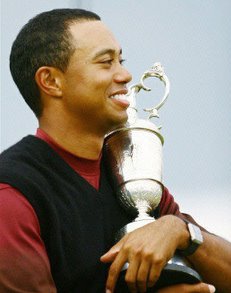
Tiger Woods carries the 'Claret Jug' after winning the 134th Open Championship at St. Andrews in July 2005. Woods, who celebrated his 30th birthday on Friday, has agreed to buy a 10-acre oceanfront estate on Jupiter Island, Florida, for 40 million dollars.
Sunday, January 01, 2006
Paradise lost? South Florida moves to tipping point
Published January 1, 2006
From her seat behind the rental counter at the U-Haul Center on State Road 84 near Interstate 95 in Fort Lauderdale, Belkis Lopez has noticed a shift in the past year.
More trucks are leaving town than arriving.
"A lot of people are getting out of here," Lopez said. "Working people who say they can't afford living here, people who've been here 50 years, retirees who say their money can go a lot further up north."
Some go as close as Fort Pierce and Port St. Lucie. Many have been going to Pensacola and Tallahassee. Some go to Georgia, North Carolina and beyond.
She rattled off the list of one-way rental destinations for the past week: Ohio, Las Vegas, two in North Florida.
"I hear the same complaints [about South Florida] all the time," said Lopez, 23, who has worked at the U-Haul Center for two years. "Too expensive, too crowded, too much traffic."
It's a new year in South Florida, and there seems to be a new vibe, too.
Not too long ago, this area seemed like paradise: great weather and a relatively affordable lifestyle, with housing that seemed a steal compared with other major metropolitan areas.
But now paradise has been lost, what with hurricanes every other week, a real estate market that only a Wall Street millionaire could afford, the cost of everything from health care to FPL bills soaring and salaries not keeping pace.
During the past few months, since Hurricane Wilma, almost every interview and casual conversation I've had with ordinary people inevitably drifts to thoughts of leaving.
"I'm seriously thinking about getting out of the area," Linda Mastriana, 57, said a few days after Wilma. She has lived and worked in Fort Lauderdale for 28 years, but she said the coming increase in windstorm insurance rates might be her breaking point.
"The cost of living is just getting out of hand, and the wages are simply not keeping up," Mastriana said. She said her native Ohio keeps looking better, winters and all.
South Florida has always been a transient area. But now it's also longtime residents, people who thought they were going to be lifers, who are pulling up stakes.
People like Martha Norona. Norona's family moved to South Florida from Massachusetts in 1957, when she was 4. In August, one week before Hurricane Katrina hit, Norona sold her house in Dania Beach and moved to Tallahassee.
Norona, 52, moved to be near her two grandchildren and daughter, who works at Florida State University, but also for a less hectic lifestyle.
"I knew things were expensive [in South Florida], but I didn't realize how expensive until I got here," she said. "I only need one insurance policy for my home now. It's wonderful."
In South Florida, she paid more than $2,000 a year for homeowner's, flood and windstorm insurance, another $2,000 in property taxes and $159 a month for auto insurance. In Tallahassee, she pays $800 a year for property insurance, $1,200 in property taxes and $88 a month for auto insurance.
She sold her South Florida house, a small two-bedroom, for $325,000. In Tallahassee, she bought a three-bedroom, two-bathroom home with a fireplace, wooden deck and two-car garage for $180,000. She had plenty left over to buy a winter wardrobe.
"I paid off everything I owed, put money in the bank, bought a beautiful house and can afford to work part-time," she said. "I don't regret it for a minute. I miss my friends and my family, but to me it's like heaven up here. … Everyone's in a good mood. Even the stock boys at Wal-Mart say hello to you. People don't cut you off in traffic. If you put your blinker on, they actually let you in."
Government planners and private builders still forecast unbridled growth for Broward, with no shortage of high-end developments and high-rise condominiums on the drawing boards. But you wonder, who'll be able to afford it?
The big question for the new year and beyond: Can South Florida's middle class hold? Or will more people cash out, pack up and escape from a lost paradise?
Michael Mayo can be reached at mmayo@sun-sentinel.com or 954-356-4508.
Copyright © 2005, South Florida Sun-Sentinel
From her seat behind the rental counter at the U-Haul Center on State Road 84 near Interstate 95 in Fort Lauderdale, Belkis Lopez has noticed a shift in the past year.
More trucks are leaving town than arriving.
"A lot of people are getting out of here," Lopez said. "Working people who say they can't afford living here, people who've been here 50 years, retirees who say their money can go a lot further up north."
Some go as close as Fort Pierce and Port St. Lucie. Many have been going to Pensacola and Tallahassee. Some go to Georgia, North Carolina and beyond.
She rattled off the list of one-way rental destinations for the past week: Ohio, Las Vegas, two in North Florida.
"I hear the same complaints [about South Florida] all the time," said Lopez, 23, who has worked at the U-Haul Center for two years. "Too expensive, too crowded, too much traffic."
It's a new year in South Florida, and there seems to be a new vibe, too.
Not too long ago, this area seemed like paradise: great weather and a relatively affordable lifestyle, with housing that seemed a steal compared with other major metropolitan areas.
But now paradise has been lost, what with hurricanes every other week, a real estate market that only a Wall Street millionaire could afford, the cost of everything from health care to FPL bills soaring and salaries not keeping pace.
During the past few months, since Hurricane Wilma, almost every interview and casual conversation I've had with ordinary people inevitably drifts to thoughts of leaving.
"I'm seriously thinking about getting out of the area," Linda Mastriana, 57, said a few days after Wilma. She has lived and worked in Fort Lauderdale for 28 years, but she said the coming increase in windstorm insurance rates might be her breaking point.
"The cost of living is just getting out of hand, and the wages are simply not keeping up," Mastriana said. She said her native Ohio keeps looking better, winters and all.
South Florida has always been a transient area. But now it's also longtime residents, people who thought they were going to be lifers, who are pulling up stakes.
People like Martha Norona. Norona's family moved to South Florida from Massachusetts in 1957, when she was 4. In August, one week before Hurricane Katrina hit, Norona sold her house in Dania Beach and moved to Tallahassee.
Norona, 52, moved to be near her two grandchildren and daughter, who works at Florida State University, but also for a less hectic lifestyle.
"I knew things were expensive [in South Florida], but I didn't realize how expensive until I got here," she said. "I only need one insurance policy for my home now. It's wonderful."
In South Florida, she paid more than $2,000 a year for homeowner's, flood and windstorm insurance, another $2,000 in property taxes and $159 a month for auto insurance. In Tallahassee, she pays $800 a year for property insurance, $1,200 in property taxes and $88 a month for auto insurance.
She sold her South Florida house, a small two-bedroom, for $325,000. In Tallahassee, she bought a three-bedroom, two-bathroom home with a fireplace, wooden deck and two-car garage for $180,000. She had plenty left over to buy a winter wardrobe.
"I paid off everything I owed, put money in the bank, bought a beautiful house and can afford to work part-time," she said. "I don't regret it for a minute. I miss my friends and my family, but to me it's like heaven up here. … Everyone's in a good mood. Even the stock boys at Wal-Mart say hello to you. People don't cut you off in traffic. If you put your blinker on, they actually let you in."
Government planners and private builders still forecast unbridled growth for Broward, with no shortage of high-end developments and high-rise condominiums on the drawing boards. But you wonder, who'll be able to afford it?
The big question for the new year and beyond: Can South Florida's middle class hold? Or will more people cash out, pack up and escape from a lost paradise?
Michael Mayo can be reached at mmayo@sun-sentinel.com or 954-356-4508.
Copyright © 2005, South Florida Sun-Sentinel
Wednesday, December 28, 2005
Revealed: the pill that prevents cancer
The Independent
28 December 2005
By Jeremy Laurance, Health Editor
A daily dose of vitamin D could cut the risk of cancers of the breast, colon and ovary by up to a half, a 40-year review of research has found. The evidence for the protective effect of the "sunshine vitamin" is so overwhelming that urgent action must be taken by public health authorities to boost blood levels, say cancer specialists.
A growing body of evidence in recent years has shown that lack of vitamin D may have lethal effects. Heart disease, lung disease, cancer, diabetes, high blood pressure, schizophrenia and multiple sclerosis are among the conditions in which it is believed to play a vital role. The vitamin is also essential for bone health and protects against rickets in children and osteoporosis in the elderly.
Vitamin D is made by the action of sunlight on the skin, which accounts for 90 per cent of the body's supply. But the increasing use of sunscreens and the reduced time spent outdoors, especially by children, has contributed to what many scientists believe is an increasing problem of vitamin D deficiency.
After assessing almost every scientific paper published on the link between vitamin D and cancer since the 1960s, US scientists say that a daily dose of 1,000 international units (25 micrograms) is needed to maintain health. " The high prevalence of vitamin D deficiency combined with the discovery of increased risks of certain types of cancer in those who are deficient, suggest that vitamin D deficiency may account for several thousand premature deaths from colon, breast, ovarian and other cancers annually," they say in the online version of the American Journal of Public Health.
The dose they propose of 1,000IU a day is two-and-a-half times the current recommended level in the US. In the UK, there is no official recommended dose but grey skies and short days from October to March mean 60 per cent of the population has inadequate blood levels by the end of winter.
The UK Food Standards Agency maintains that most people should be able to get all the vitamin D they need from their diet and "by getting a little sun". But the vitamin can only be stored in the body for 60 days.
High rates of heart disease in Scotland have been blamed on the weak sunlight and short summers in the north, leading to low levels of vitamin D. Differences in sunlight may also explain the higher rates of heart disease in England compared with southern Europe. Some experts believe the health benefits of the Mediterranean diet may have as much to do with the sun there as with the regional food.
Countries around the world have begun to modify their warnings about the dangers of sunbathing, as a result of the growing research on vitamin D. The Association of Cancer Councils of Australia acknowledged this year for the first time that some exposure to the sun was healthy.
Australia is one of the world's sunniest countries and has among the highest rates of skin cancer. For three decades it has preached sun avoidance with its "slip, slap, slop" campaign to cover up and use sunscreen. But in a statement in March, the association said: "A balance is required between avoiding an increase in the risk of skin cancer and achieving enough ultraviolet radiation exposure to achieve adequate vitamin D levels." Bruce Armstrong, the professor of public health at Sydney University, said: " It is a revolution."
In the latest study, cancer specialists from the University of San Diego, California, led by Professor Cedric Garland, reviewed 63 scientific papers on the link between vitamin D and cancer published between 1966 and 2004. People living in the north-eastern US, where it is less sunny, and African Americans with darker skins were more likely to be deficient, researchers found. They also had higher cancer rates.
The researchers say their finding could explain why black Americans die sooner from cancer than whites, even after allowing for differences in income and access to care.
Professor Garland said: "A preponderance of evidence from the best observational studies... has led to the conclusion that public health action is needed. Primary prevention of these cancers has been largely neglected, but we now have proof that the incidence of colon, breast and ovarian cancer can be reduced dramatically by increasing the public's intake of vitamin D." Obtaining the necessary level of vitamin D from diet alone would be difficult and sun exposure carries a risk of triggering skin cancer. "The easiest and most reliable way of getting the appropriate amount is from food and a daily supplement," they say.
The cost of a vitamin D supplement is about 4p a day. The UK Food Standards Agency said that taking Vitamin D supplements of up to 1,000IU was " unlikely to cause harm".
What it can do
Heart disease
Vitamin D works by lowering insulin resistance, which is one of the major factors leading to heart disease.
Lung disease
Lung tissue undergoes repair and "remodelling" in life and, since vitamin D influences the growth of a variety of cell types, it may play a role in this lung repair process.
Cancers (breast, colon, ovary, prostate)
Vitamin D is believed to play an important role in regulating the production of cells, a control that is missing in cancer. It has a protective effect against certain cancers by preventing overproduction of cells.
Diabetes
In type 1 diabetes the immune system destroys its own cells. Vitamin D is believed to act as an immunosuppressant. Researchers believe it may prevent an overly aggressive response from the immune system.
High blood pressure
Vitamin D is used by the parathyroid glands that sit on the thyroid gland in the neck. These secrete a hormone that regulates the body's calcium levels. Calcium, in turn, helps to regulate blood pressure, although the mechanism is not yet completely understood.
Schizophrenia
The chance of developing schizophrenia could be linked to how sunny it was in the months before birth. A lack of sunlight can lead to vitamin D deficiency, which scientists believe could alter the growth of a child's brain in the womb.
Multiple sclerosis
Lack of vitamin D leads to limited production of 1.25-dihydroxyvitamin D3, the hormonal form of vitamin D3 which regulates the immune system, creating a risk for MS.
Rickets and osteoporosis
The vitamin strengthens bones, protecting against childhood rickets and osteoporosis in the elderly.
A daily dose of vitamin D could cut the risk of cancers of the breast, colon and ovary by up to a half, a 40-year review of research has found. The evidence for the protective effect of the "sunshine vitamin" is so overwhelming that urgent action must be taken by public health authorities to boost blood levels, say cancer specialists.
A growing body of evidence in recent years has shown that lack of vitamin D may have lethal effects. Heart disease, lung disease, cancer, diabetes, high blood pressure, schizophrenia and multiple sclerosis are among the conditions in which it is believed to play a vital role. The vitamin is also essential for bone health and protects against rickets in children and osteoporosis in the elderly.
Vitamin D is made by the action of sunlight on the skin, which accounts for 90 per cent of the body's supply. But the increasing use of sunscreens and the reduced time spent outdoors, especially by children, has contributed to what many scientists believe is an increasing problem of vitamin D deficiency.
After assessing almost every scientific paper published on the link between vitamin D and cancer since the 1960s, US scientists say that a daily dose of 1,000 international units (25 micrograms) is needed to maintain health. " The high prevalence of vitamin D deficiency combined with the discovery of increased risks of certain types of cancer in those who are deficient, suggest that vitamin D deficiency may account for several thousand premature deaths from colon, breast, ovarian and other cancers annually," they say in the online version of the American Journal of Public Health.
The dose they propose of 1,000IU a day is two-and-a-half times the current recommended level in the US. In the UK, there is no official recommended dose but grey skies and short days from October to March mean 60 per cent of the population has inadequate blood levels by the end of winter.
The UK Food Standards Agency maintains that most people should be able to get all the vitamin D they need from their diet and "by getting a little sun". But the vitamin can only be stored in the body for 60 days.
High rates of heart disease in Scotland have been blamed on the weak sunlight and short summers in the north, leading to low levels of vitamin D. Differences in sunlight may also explain the higher rates of heart disease in England compared with southern Europe. Some experts believe the health benefits of the Mediterranean diet may have as much to do with the sun there as with the regional food.
Countries around the world have begun to modify their warnings about the dangers of sunbathing, as a result of the growing research on vitamin D. The Association of Cancer Councils of Australia acknowledged this year for the first time that some exposure to the sun was healthy.
Australia is one of the world's sunniest countries and has among the highest rates of skin cancer. For three decades it has preached sun avoidance with its "slip, slap, slop" campaign to cover up and use sunscreen. But in a statement in March, the association said: "A balance is required between avoiding an increase in the risk of skin cancer and achieving enough ultraviolet radiation exposure to achieve adequate vitamin D levels." Bruce Armstrong, the professor of public health at Sydney University, said: " It is a revolution."
In the latest study, cancer specialists from the University of San Diego, California, led by Professor Cedric Garland, reviewed 63 scientific papers on the link between vitamin D and cancer published between 1966 and 2004. People living in the north-eastern US, where it is less sunny, and African Americans with darker skins were more likely to be deficient, researchers found. They also had higher cancer rates.
The researchers say their finding could explain why black Americans die sooner from cancer than whites, even after allowing for differences in income and access to care.
Professor Garland said: "A preponderance of evidence from the best observational studies... has led to the conclusion that public health action is needed. Primary prevention of these cancers has been largely neglected, but we now have proof that the incidence of colon, breast and ovarian cancer can be reduced dramatically by increasing the public's intake of vitamin D." Obtaining the necessary level of vitamin D from diet alone would be difficult and sun exposure carries a risk of triggering skin cancer. "The easiest and most reliable way of getting the appropriate amount is from food and a daily supplement," they say.
The cost of a vitamin D supplement is about 4p a day. The UK Food Standards Agency said that taking Vitamin D supplements of up to 1,000IU was " unlikely to cause harm".
What it can do
Heart disease
Vitamin D works by lowering insulin resistance, which is one of the major factors leading to heart disease.
Lung disease
Lung tissue undergoes repair and "remodelling" in life and, since vitamin D influences the growth of a variety of cell types, it may play a role in this lung repair process.
Cancers (breast, colon, ovary, prostate)
Vitamin D is believed to play an important role in regulating the production of cells, a control that is missing in cancer. It has a protective effect against certain cancers by preventing overproduction of cells.
Diabetes
In type 1 diabetes the immune system destroys its own cells. Vitamin D is believed to act as an immunosuppressant. Researchers believe it may prevent an overly aggressive response from the immune system.
High blood pressure
Vitamin D is used by the parathyroid glands that sit on the thyroid gland in the neck. These secrete a hormone that regulates the body's calcium levels. Calcium, in turn, helps to regulate blood pressure, although the mechanism is not yet completely understood.
Schizophrenia
The chance of developing schizophrenia could be linked to how sunny it was in the months before birth. A lack of sunlight can lead to vitamin D deficiency, which scientists believe could alter the growth of a child's brain in the womb.
Multiple sclerosis
Lack of vitamin D leads to limited production of 1.25-dihydroxyvitamin D3, the hormonal form of vitamin D3 which regulates the immune system, creating a risk for MS.
Rickets and osteoporosis
The vitamin strengthens bones, protecting against childhood rickets and osteoporosis in the elderly.
28 December 2005
By Jeremy Laurance, Health Editor
A daily dose of vitamin D could cut the risk of cancers of the breast, colon and ovary by up to a half, a 40-year review of research has found. The evidence for the protective effect of the "sunshine vitamin" is so overwhelming that urgent action must be taken by public health authorities to boost blood levels, say cancer specialists.
A growing body of evidence in recent years has shown that lack of vitamin D may have lethal effects. Heart disease, lung disease, cancer, diabetes, high blood pressure, schizophrenia and multiple sclerosis are among the conditions in which it is believed to play a vital role. The vitamin is also essential for bone health and protects against rickets in children and osteoporosis in the elderly.
Vitamin D is made by the action of sunlight on the skin, which accounts for 90 per cent of the body's supply. But the increasing use of sunscreens and the reduced time spent outdoors, especially by children, has contributed to what many scientists believe is an increasing problem of vitamin D deficiency.
After assessing almost every scientific paper published on the link between vitamin D and cancer since the 1960s, US scientists say that a daily dose of 1,000 international units (25 micrograms) is needed to maintain health. " The high prevalence of vitamin D deficiency combined with the discovery of increased risks of certain types of cancer in those who are deficient, suggest that vitamin D deficiency may account for several thousand premature deaths from colon, breast, ovarian and other cancers annually," they say in the online version of the American Journal of Public Health.
The dose they propose of 1,000IU a day is two-and-a-half times the current recommended level in the US. In the UK, there is no official recommended dose but grey skies and short days from October to March mean 60 per cent of the population has inadequate blood levels by the end of winter.
The UK Food Standards Agency maintains that most people should be able to get all the vitamin D they need from their diet and "by getting a little sun". But the vitamin can only be stored in the body for 60 days.
High rates of heart disease in Scotland have been blamed on the weak sunlight and short summers in the north, leading to low levels of vitamin D. Differences in sunlight may also explain the higher rates of heart disease in England compared with southern Europe. Some experts believe the health benefits of the Mediterranean diet may have as much to do with the sun there as with the regional food.
Countries around the world have begun to modify their warnings about the dangers of sunbathing, as a result of the growing research on vitamin D. The Association of Cancer Councils of Australia acknowledged this year for the first time that some exposure to the sun was healthy.
Australia is one of the world's sunniest countries and has among the highest rates of skin cancer. For three decades it has preached sun avoidance with its "slip, slap, slop" campaign to cover up and use sunscreen. But in a statement in March, the association said: "A balance is required between avoiding an increase in the risk of skin cancer and achieving enough ultraviolet radiation exposure to achieve adequate vitamin D levels." Bruce Armstrong, the professor of public health at Sydney University, said: " It is a revolution."
In the latest study, cancer specialists from the University of San Diego, California, led by Professor Cedric Garland, reviewed 63 scientific papers on the link between vitamin D and cancer published between 1966 and 2004. People living in the north-eastern US, where it is less sunny, and African Americans with darker skins were more likely to be deficient, researchers found. They also had higher cancer rates.
The researchers say their finding could explain why black Americans die sooner from cancer than whites, even after allowing for differences in income and access to care.
Professor Garland said: "A preponderance of evidence from the best observational studies... has led to the conclusion that public health action is needed. Primary prevention of these cancers has been largely neglected, but we now have proof that the incidence of colon, breast and ovarian cancer can be reduced dramatically by increasing the public's intake of vitamin D." Obtaining the necessary level of vitamin D from diet alone would be difficult and sun exposure carries a risk of triggering skin cancer. "The easiest and most reliable way of getting the appropriate amount is from food and a daily supplement," they say.
The cost of a vitamin D supplement is about 4p a day. The UK Food Standards Agency said that taking Vitamin D supplements of up to 1,000IU was " unlikely to cause harm".
What it can do
Heart disease
Vitamin D works by lowering insulin resistance, which is one of the major factors leading to heart disease.
Lung disease
Lung tissue undergoes repair and "remodelling" in life and, since vitamin D influences the growth of a variety of cell types, it may play a role in this lung repair process.
Cancers (breast, colon, ovary, prostate)
Vitamin D is believed to play an important role in regulating the production of cells, a control that is missing in cancer. It has a protective effect against certain cancers by preventing overproduction of cells.
Diabetes
In type 1 diabetes the immune system destroys its own cells. Vitamin D is believed to act as an immunosuppressant. Researchers believe it may prevent an overly aggressive response from the immune system.
High blood pressure
Vitamin D is used by the parathyroid glands that sit on the thyroid gland in the neck. These secrete a hormone that regulates the body's calcium levels. Calcium, in turn, helps to regulate blood pressure, although the mechanism is not yet completely understood.
Schizophrenia
The chance of developing schizophrenia could be linked to how sunny it was in the months before birth. A lack of sunlight can lead to vitamin D deficiency, which scientists believe could alter the growth of a child's brain in the womb.
Multiple sclerosis
Lack of vitamin D leads to limited production of 1.25-dihydroxyvitamin D3, the hormonal form of vitamin D3 which regulates the immune system, creating a risk for MS.
Rickets and osteoporosis
The vitamin strengthens bones, protecting against childhood rickets and osteoporosis in the elderly.
A daily dose of vitamin D could cut the risk of cancers of the breast, colon and ovary by up to a half, a 40-year review of research has found. The evidence for the protective effect of the "sunshine vitamin" is so overwhelming that urgent action must be taken by public health authorities to boost blood levels, say cancer specialists.
A growing body of evidence in recent years has shown that lack of vitamin D may have lethal effects. Heart disease, lung disease, cancer, diabetes, high blood pressure, schizophrenia and multiple sclerosis are among the conditions in which it is believed to play a vital role. The vitamin is also essential for bone health and protects against rickets in children and osteoporosis in the elderly.
Vitamin D is made by the action of sunlight on the skin, which accounts for 90 per cent of the body's supply. But the increasing use of sunscreens and the reduced time spent outdoors, especially by children, has contributed to what many scientists believe is an increasing problem of vitamin D deficiency.
After assessing almost every scientific paper published on the link between vitamin D and cancer since the 1960s, US scientists say that a daily dose of 1,000 international units (25 micrograms) is needed to maintain health. " The high prevalence of vitamin D deficiency combined with the discovery of increased risks of certain types of cancer in those who are deficient, suggest that vitamin D deficiency may account for several thousand premature deaths from colon, breast, ovarian and other cancers annually," they say in the online version of the American Journal of Public Health.
The dose they propose of 1,000IU a day is two-and-a-half times the current recommended level in the US. In the UK, there is no official recommended dose but grey skies and short days from October to March mean 60 per cent of the population has inadequate blood levels by the end of winter.
The UK Food Standards Agency maintains that most people should be able to get all the vitamin D they need from their diet and "by getting a little sun". But the vitamin can only be stored in the body for 60 days.
High rates of heart disease in Scotland have been blamed on the weak sunlight and short summers in the north, leading to low levels of vitamin D. Differences in sunlight may also explain the higher rates of heart disease in England compared with southern Europe. Some experts believe the health benefits of the Mediterranean diet may have as much to do with the sun there as with the regional food.
Countries around the world have begun to modify their warnings about the dangers of sunbathing, as a result of the growing research on vitamin D. The Association of Cancer Councils of Australia acknowledged this year for the first time that some exposure to the sun was healthy.
Australia is one of the world's sunniest countries and has among the highest rates of skin cancer. For three decades it has preached sun avoidance with its "slip, slap, slop" campaign to cover up and use sunscreen. But in a statement in March, the association said: "A balance is required between avoiding an increase in the risk of skin cancer and achieving enough ultraviolet radiation exposure to achieve adequate vitamin D levels." Bruce Armstrong, the professor of public health at Sydney University, said: " It is a revolution."
In the latest study, cancer specialists from the University of San Diego, California, led by Professor Cedric Garland, reviewed 63 scientific papers on the link between vitamin D and cancer published between 1966 and 2004. People living in the north-eastern US, where it is less sunny, and African Americans with darker skins were more likely to be deficient, researchers found. They also had higher cancer rates.
The researchers say their finding could explain why black Americans die sooner from cancer than whites, even after allowing for differences in income and access to care.
Professor Garland said: "A preponderance of evidence from the best observational studies... has led to the conclusion that public health action is needed. Primary prevention of these cancers has been largely neglected, but we now have proof that the incidence of colon, breast and ovarian cancer can be reduced dramatically by increasing the public's intake of vitamin D." Obtaining the necessary level of vitamin D from diet alone would be difficult and sun exposure carries a risk of triggering skin cancer. "The easiest and most reliable way of getting the appropriate amount is from food and a daily supplement," they say.
The cost of a vitamin D supplement is about 4p a day. The UK Food Standards Agency said that taking Vitamin D supplements of up to 1,000IU was " unlikely to cause harm".
What it can do
Heart disease
Vitamin D works by lowering insulin resistance, which is one of the major factors leading to heart disease.
Lung disease
Lung tissue undergoes repair and "remodelling" in life and, since vitamin D influences the growth of a variety of cell types, it may play a role in this lung repair process.
Cancers (breast, colon, ovary, prostate)
Vitamin D is believed to play an important role in regulating the production of cells, a control that is missing in cancer. It has a protective effect against certain cancers by preventing overproduction of cells.
Diabetes
In type 1 diabetes the immune system destroys its own cells. Vitamin D is believed to act as an immunosuppressant. Researchers believe it may prevent an overly aggressive response from the immune system.
High blood pressure
Vitamin D is used by the parathyroid glands that sit on the thyroid gland in the neck. These secrete a hormone that regulates the body's calcium levels. Calcium, in turn, helps to regulate blood pressure, although the mechanism is not yet completely understood.
Schizophrenia
The chance of developing schizophrenia could be linked to how sunny it was in the months before birth. A lack of sunlight can lead to vitamin D deficiency, which scientists believe could alter the growth of a child's brain in the womb.
Multiple sclerosis
Lack of vitamin D leads to limited production of 1.25-dihydroxyvitamin D3, the hormonal form of vitamin D3 which regulates the immune system, creating a risk for MS.
Rickets and osteoporosis
The vitamin strengthens bones, protecting against childhood rickets and osteoporosis in the elderly.
Monday, December 26, 2005
ABC Bids Farewell to Monday Night Football
Dec 26, 8:23 AM (ET)
EAST RUTHERFORD, N.J. (AP) - If you were ready for some football, it was the place to be for 35 seasons on Monday nights. Tonight, the NFL bids farewell to ABC, with the New England Patriots playing the New York Jets.
The second longest-running series on network TV shifts to ESPN beginning next season.
The series began in 1970, with Keith Jackson handling the play-by-play.
ESPN is paying about $1.1 billion over eight seasons for the Monday night contract.
EAST RUTHERFORD, N.J. (AP) - If you were ready for some football, it was the place to be for 35 seasons on Monday nights. Tonight, the NFL bids farewell to ABC, with the New England Patriots playing the New York Jets.
The second longest-running series on network TV shifts to ESPN beginning next season.
The series began in 1970, with Keith Jackson handling the play-by-play.
ESPN is paying about $1.1 billion over eight seasons for the Monday night contract.
Some more wacky stories...
When his 38-caliber revolver failed to fire at its intend-
ed victim during a holdup in Long Beach, California, would
be robber James Elliot did something that can only inspire
wonder: He peered down the barrel and tried the trigger
again. This time it worked.
************************************************************
The chef at a hotel in Switzerland lost a finger in a meat
cutting machine and, after a little hopping around, submit-
ted a claim to his insurance company. The company, suspect-
ing negligence, sent out one of its men to have a look for
himself. He tried the machine out and lost a finger also.
The chef's claim was approved.
************************************************************
A man who shoveled snow for an hour to clear a space for
his car during a blizzard in Chicago returned with his
vehicle to find a woman had taken the space. Understandably,
he shot her.
************************************************************
After stopping for drinks at an illegal bar, a Zimbabwean
bus driver found that the 20 mental patients he was supposed
to be transporting from Harare to Bulawayo had escaped. Not
wanting to admit his incompetence, the driver went to a
nearby bus-stop and offered everyone waiting there a free
ride. He then delivered the passengers to the mental hospital,
telling the staff that the patients were very excitable and
prone to bizarre fantasies. The deception wasn't discovered
for 3 days.
ed victim during a holdup in Long Beach, California, would
be robber James Elliot did something that can only inspire
wonder: He peered down the barrel and tried the trigger
again. This time it worked.
************************************************************
The chef at a hotel in Switzerland lost a finger in a meat
cutting machine and, after a little hopping around, submit-
ted a claim to his insurance company. The company, suspect-
ing negligence, sent out one of its men to have a look for
himself. He tried the machine out and lost a finger also.
The chef's claim was approved.
************************************************************
A man who shoveled snow for an hour to clear a space for
his car during a blizzard in Chicago returned with his
vehicle to find a woman had taken the space. Understandably,
he shot her.
************************************************************
After stopping for drinks at an illegal bar, a Zimbabwean
bus driver found that the 20 mental patients he was supposed
to be transporting from Harare to Bulawayo had escaped. Not
wanting to admit his incompetence, the driver went to a
nearby bus-stop and offered everyone waiting there a free
ride. He then delivered the passengers to the mental hospital,
telling the staff that the patients were very excitable and
prone to bizarre fantasies. The deception wasn't discovered
for 3 days.
Sunday, December 25, 2005
Roundup of wacky stories
The U.S. Supreme Court has allowed Shawn Gementera, a
California man who pleaded guilty to mail theft, to be
sentenced to spend a day outside a post office wearing a sign
stating: “I stole mail. This is my punishment.”
A 22-year-old named Ronald MacDonald was charged with
stealing money from a Wendy where he worked in
New Hampshire.
Christina Destorges, a 15-year-old Canadian girl with a
peanut allergy, died after kissing her boyfriend, who had
just eaten a peanut snack.
In a study by The Adelaide and Meath Hospital in Dublin,
Ireland, researchers concluded fatter rear ends are causing
drug injections to miss their mark, the buttock muscle, and
longer needles may be required.
From his deathbed, rocker Johnny Ramone
advocated for the nomination of Cat Stevens to the Rock ‘n’
Roll Hall of Fame. A year and half later, Stevens’ name
appeared on the ballot, though he did not win induction.
A Pennsylvania farmer painted his cows, horses and dog
bright orange so hunters wouldn’t mistake them for deer.
California man who pleaded guilty to mail theft, to be
sentenced to spend a day outside a post office wearing a sign
stating: “I stole mail. This is my punishment.”
A 22-year-old named Ronald MacDonald was charged with
stealing money from a Wendy where he worked in
New Hampshire.
Christina Destorges, a 15-year-old Canadian girl with a
peanut allergy, died after kissing her boyfriend, who had
just eaten a peanut snack.
In a study by The Adelaide and Meath Hospital in Dublin,
Ireland, researchers concluded fatter rear ends are causing
drug injections to miss their mark, the buttock muscle, and
longer needles may be required.
From his deathbed, rocker Johnny Ramone
advocated for the nomination of Cat Stevens to the Rock ‘n’
Roll Hall of Fame. A year and half later, Stevens’ name
appeared on the ballot, though he did not win induction.
A Pennsylvania farmer painted his cows, horses and dog
bright orange so hunters wouldn’t mistake them for deer.
Headlines that caught my attention and my annoying comments
MERRY CHRISTMAS Y'ALL
CELEBRITIES REFUSE TO ENTERTAIN TROOPS...
They just love the military. We need another Bob Hope
JOHNNY CASH ON CHENEY'S I-POD...
The VP is hip. I don't even have an I-pod
Feds Monitor Muslims Without Warrants; Search For Nukes...
Awesome. Just don't tell the whole world.
Thwarted al-Qaida plot to kill Bush reported...
They got nothing, we kick ass.
China recruiting U.S. IT grads...
Scary.
Russia deploys new set of strategic nuclear missiles...
Putin is a scary dude. Ex-KGB...I wouldn't trust him
Christmas Eve sales slower than predicted
Predicted by who? Do they have a crystal ball?
Moderate Quake Shakes Pakistan
See, not only us infidels get hit.
Wait a sec for leap into 2006
Oh my god! The Earth is slowing down. Bush better do something about it.
Beware, Barbie! Kids Find Torturing Fun
Kids will be kids.
CHOLESTEROL DRUG MAY BE A LOT MORE
Phenomenal. We may never die. Now we just gotta fix Social Security.
Lawyer demands probe into Saddam torture claim
Why is this even news?
Bush, GOP Downsize Ambitions for 2006
Good. He's got too much in his plate already. Stick to protecting the country
which is his main and most important responsibility. Where in the constitution does it say that the President is responsible for all this other crap.
Vineyard in a box is must-have gift for Italian townies
I want one!!
CELEBRITIES REFUSE TO ENTERTAIN TROOPS...
They just love the military. We need another Bob Hope
JOHNNY CASH ON CHENEY'S I-POD...
The VP is hip. I don't even have an I-pod
Feds Monitor Muslims Without Warrants; Search For Nukes...
Awesome. Just don't tell the whole world.
Thwarted al-Qaida plot to kill Bush reported...
They got nothing, we kick ass.
China recruiting U.S. IT grads...
Scary.
Russia deploys new set of strategic nuclear missiles...
Putin is a scary dude. Ex-KGB...I wouldn't trust him
Christmas Eve sales slower than predicted
Predicted by who? Do they have a crystal ball?
Moderate Quake Shakes Pakistan
See, not only us infidels get hit.
Wait a sec for leap into 2006
Oh my god! The Earth is slowing down. Bush better do something about it.
Beware, Barbie! Kids Find Torturing Fun
Kids will be kids.
CHOLESTEROL DRUG MAY BE A LOT MORE
Phenomenal. We may never die. Now we just gotta fix Social Security.
Lawyer demands probe into Saddam torture claim
Why is this even news?
Bush, GOP Downsize Ambitions for 2006
Good. He's got too much in his plate already. Stick to protecting the country
which is his main and most important responsibility. Where in the constitution does it say that the President is responsible for all this other crap.
Vineyard in a box is must-have gift for Italian townies
I want one!!
Merry Christmas
 May your holidays be filled with peace and happiness in the company of your loved ones, and lets not forget about our brave troops defending our freedom in all parts of the world.
China and Cuba explore socialist development
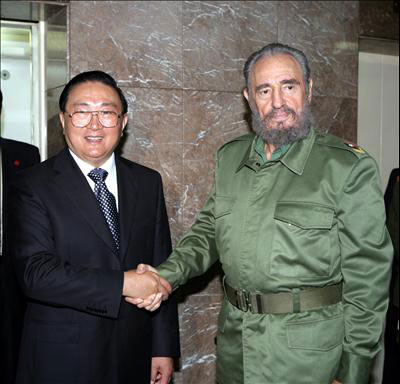
Luo Gan (L), member of the Standing Committee of the Political Bureau of the Communist Party of China Central Committee, shakes hands with Cuban leader Fidel Castro during his visit in Havana, Dec. 20, 2005. Luo began his goodwill visit to Cuba Sunday afternoon at the invitation of the Communist Party of Cuba.
Saturday, December 24, 2005
Fidel Castro Says Bush 'Very Much a Fool'
Dec 23, 9:23 PM (ET)
By ANNE-MARIE GARCIA

(AP) Cuban President Fidel Castro speaks during a Session of the Cuban Parliament, in the Palace of...
Full Image
HAVANA (AP) - Fidel Castro said Friday that the Bush administration was wrong to prohibit Cuba from sending a team to next year's World Baseball Classic.
"He is very much a fool," the Cuban president said of Bush. "He doesn't know who the Cuban baseball players are, or that they are Olympic and world champions. If he knew, he would know something about this country's government."
Castro mentioned the ongoing dispute during the second day of regular sessions of the island's National Assembly.
The U.S. Treasury Department last week rejected the application for Cuba to play in the 16-team tournament scheduled for March 3-20, evidently because of concerns that Castro's government could enjoy financial gain by participating.
Major League Baseball and the Major League Baseball Players Association, which are organizing the tournament, reapplied Thursday to the Treasury Department's Office of Foreign Assets Control. OFAC's permission is required under U.S. laws and regulations governing transactions with Cuba, which has been under an American trade and financial embargo for more than four decades.
In an attempt to eliminate a major concern of the U.S. government, the Cuban Baseball Federation announced Thursday night that any money gained by the national team would be donated to Hurricane Katrina victims.
Cuban baseball "would be willing for the money associated with participation in the classic to go to those displaced by Hurricane Katrina in New Orleans," said the statement read on state television by baseball federation president Carlos Rodriguez.
Cuba is scheduled to play first-round games in San Juan, Puerto Rico, and would remain in San Juan if it advances to the second round.
Antonio Munoz, a businessman who agreed to pay millions of dollars to bring the games to Puerto Rico, thinks the Treasury Department will reverse its decision.
"All efforts are being made to get Cuba to come and participate and I think we will succeed," Munoz told The Associated Press by telephone from New York.
---
Associated Press writer Luis R. Varela in San Juan, Puerto Rico, contributed to this report
By ANNE-MARIE GARCIA

(AP) Cuban President Fidel Castro speaks during a Session of the Cuban Parliament, in the Palace of...
Full Image
HAVANA (AP) - Fidel Castro said Friday that the Bush administration was wrong to prohibit Cuba from sending a team to next year's World Baseball Classic.
"He is very much a fool," the Cuban president said of Bush. "He doesn't know who the Cuban baseball players are, or that they are Olympic and world champions. If he knew, he would know something about this country's government."
Castro mentioned the ongoing dispute during the second day of regular sessions of the island's National Assembly.
The U.S. Treasury Department last week rejected the application for Cuba to play in the 16-team tournament scheduled for March 3-20, evidently because of concerns that Castro's government could enjoy financial gain by participating.
Major League Baseball and the Major League Baseball Players Association, which are organizing the tournament, reapplied Thursday to the Treasury Department's Office of Foreign Assets Control. OFAC's permission is required under U.S. laws and regulations governing transactions with Cuba, which has been under an American trade and financial embargo for more than four decades.
In an attempt to eliminate a major concern of the U.S. government, the Cuban Baseball Federation announced Thursday night that any money gained by the national team would be donated to Hurricane Katrina victims.
Cuban baseball "would be willing for the money associated with participation in the classic to go to those displaced by Hurricane Katrina in New Orleans," said the statement read on state television by baseball federation president Carlos Rodriguez.
Cuba is scheduled to play first-round games in San Juan, Puerto Rico, and would remain in San Juan if it advances to the second round.
Antonio Munoz, a businessman who agreed to pay millions of dollars to bring the games to Puerto Rico, thinks the Treasury Department will reverse its decision.
"All efforts are being made to get Cuba to come and participate and I think we will succeed," Munoz told The Associated Press by telephone from New York.
---
Associated Press writer Luis R. Varela in San Juan, Puerto Rico, contributed to this report
Subscribe to:
Posts (Atom)