

Spidery black objects on Mars surface raise speculation

By Eric Pfeiffer, Yahoo! News
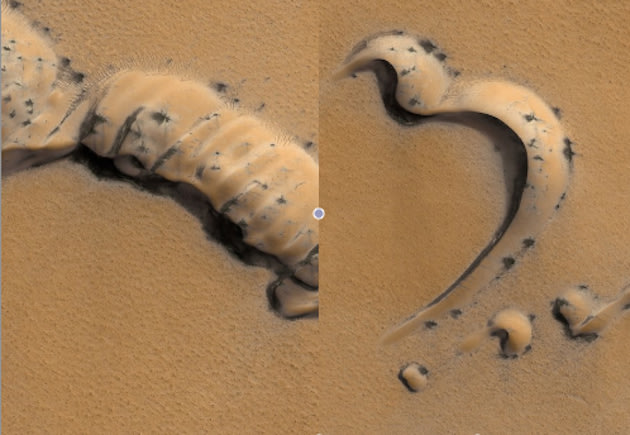 Scientists are trying to identify the strange black "spidery" objects in these images (Michael Benson/NASA/JPL/University …
Someone alert Ziggy Stardust, there appear to be spiders on Mars.
Strange, black objects seen from 200 miles above the surface of Mars are generating interest and speculation that the unidentified objects could be anything from geysers to sunbathing colonies of microorganisms.
NPR compares several photos of the objects, including one taken by the Mars Reconnaissance Orbiter on Jan. 27, which appears to show, "little black flecks dotting the ridges, mostly on the sunny side, like sunbathing spiders sitting in rows."
The objects were first spotted in 1998. Interestingly, they appear when the surface of Mars begins to warm, appearing in the same location most of the time. And then, when the Martian winter approaches, they disappear with the same precise regularity. The images have been brought into greater detail by Michael Benson, in his book "Planetfall: New Solar System Visions."
Most scientists, including teams from the U.S. Geological Survey, from Hungary, from the European Space Agency all have their own theories but the leading explanation is that the objects are geysers of CO2 exploding from underneath the planet's surface.
"If you were there, you'd be standing on a slab of carbon dioxide ice," Phil Christensen of Arizona State University told NPR. "All around you, roaring jets of carbon dioxide gas are throwing sand and dust a couple hundred feet into the air. The ground below would be rumbling. You'd feel it in your spaceboots."
And while the geyser theory is the most popular explanation, it has yet to be factually verified.
In the meantime, there are some interesting alternative theories, including one from a group of Hungarian scientists, who have speculated that the objects are actually colonies of photosynthetic Martian microorganisms who emerge each year to sunbathe in the warm weather.
 What the objects may look like up close (Artist rendering by Ron Miller/JPL/Arizona State University

No comments:
Post a Comment